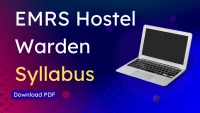

EMRS Hostel Warden Syllabus 2026: The Eklavya Model Residential Schools (EMRS) recruitment drive is one of the most anticipated opportunities for candidates seeking non-teaching government roles in the education sector. The Hostel Warden (Male/Female) position is particularly significant, as it involves ensuring the safety and well-being of students and overseeing administrative management in residential schools. The National Education Society for Tribal Students (NESTS) conducts this examination, and candidates must prepare for a highly competitive selection process. Success in this exam relies heavily on mastering the unique sections of the syllabus, such as Administrative Aptitude and the POCSO Act, which carry significant weightage alongside standard subjects.
EMRS Hostel Warden Recruitment 2026: Overview
| Organization | National Education Society for Tribal Students (NESTS) |
| Exam Name | EMRS Staff Selection Exam (ESSE) – 2026 |
| Post Name | Hostel Warden (Male & Female) |
| Category | Syllabus & Exam Pattern |
| Mode of Exam | OMR Based (Offline) |
| Total Marks | 120 Marks |
| Selection Process | Written Examination & Document Verification |
| Official Website | emrs.tribal.gov.in |
Selection Criteria
The selection process for the EMRS Hostel Warden post is straightforward but rigorous. Unlike teaching posts (like PGTs) or administrative posts (like JSAs) that may require interviews or skill tests, the Hostel Warden selection is primarily based on a single stage:
- Written Examination (OMR-Based): A comprehensive objective-type test assessing general and subject-specific knowledge.
- Document Verification (DV): Candidates who qualify for the written exam are called for verification of eligibility, caste, and educational certificates.
- Medical Examination: Final fitness check before joining.
Note: There is typically no interview and no skill test for the Hostel Warden post. The merit list is prepared solely based on the marks obtained in the Written Examination.
Exam Pattern 2026
The exam pattern is expected to follow the standard 120-mark structure. The test is bilingual (Hindi & English), except for the Language Competency section.
- Exam Type: Objective (Multiple Choice Questions)
- Total Duration: 2.5 Hours (150 Minutes)
- Negative Marking: 0.25 marks (1/4th) deduction for every incorrect answer.
| Part | Section Name | No. of Questions | Total Marks |
| I | General Awareness | 10 | 10 |
| II | Reasoning Ability | 20 | 20 |
| III | Knowledge of ICT (Computers) | 20 | 20 |
| IV | Knowledge of POCSO & Children Safety Acts | 10 | 10 |
| V | Administrative Aptitude | 30 | 30 |
| VI | Language Competency (General Hindi, General English & Regional Language) | 30 | 30 |
| Total | — | 120 | 120 |
Topic-Wise Syllabus 2026
The syllabus covers a blend of general aptitude and specific domain knowledge required for managing a hostel environment. The Administrative Aptitude and Child Safety (POCSO) sections are the most critical differentiators for this exam.
| Subject | Detailed Topics |
| General Awareness | General Knowledge with a special emphasis on the field of Education; Current Affairs (National & International); Static GK (Polity, History, Geography of India). |
| Reasoning Ability | Puzzles & Seating Arrangement; Data Sufficiency; Statement-based questions (Verbal Reasoning); Inequality; Blood Relations; Sequences and Series; Direction Test; Assertion and Reason; Venn Diagrams. |
| Knowledge of ICT | Fundamentals of Computer Systems; Basics of Operating Systems; MS Office (Word, Excel, PowerPoint); Keyboard Shortcuts; Important Computer Terms & Abbreviations; Computer Networks; Cyber Security; Internet usage. |
| POCSO & Child Safety Acts | Prohibition of Child Marriage Act (2006); The Protection of Children from Sexual Offences Act (2012) & Rules 2020; The Child Labour (Prohibition and Regulation) Act (1986); The Immoral Traffic Prevention Amendment Bill (2006); The Commission for Protection of Child Rights Act (2005); The Right of Children to Free and Compulsory Education Act 2009 (RTE); Criminal Law Amendment Act 2013; Child Policy; National Charter of Children; Child Mortality Rate; Gender Ratio. |
| Administrative Aptitude | Handling of a large number of students; Managing consumables and inventories of the Hostel; Ensuring safety and security of children; Segregation of male and female students; Ensuring cleanliness of hostel premises; Record management of children. |
| Language Competency | General English: Verb, Tenses, Voice, Subject-Verb Agreement, Articles, Comprehension, Fill in the Blanks, Adverb, Error Correction, Vocabulary, Antonyms/Synonyms, Idioms. General Hindi: Sandhi, Samas, Vilom Shabd, Paryayvacchi, Muhavare, Unseen Passage. Regional Language: Basic grammar (Synonyms, Antonyms, One Word Substitution, Error Detection) in the language opted by the candidate (e.g., Telugu, Hindi, Bengali, etc.). |
Preparation Tips for EMRS Hostel Warden 2026
Master the Unique Sections: Devote at least 40% of your study time to Administrative Aptitude and the POCSO Act. These sections account for 40 marks and are often the deciding factor since standard aspirants may not be familiar with them.
Focus on Education GK: In the General Awareness section, prioritize news and static facts related to the education sector, tribal welfare schemes (like Eklavya Schools), and government initiatives for students.
Language is Scoring: The Language Competency section (30 marks) is high-scoring. Ensure you practice basic grammar for English and Hindi daily. Do not neglect the Regional Language section.
Practice OMR Sheets: Since the exam is offline, practice marking answers on a physical OMR sheet to avoid bubbling errors during the actual exam.
Current Affairs: Stay updated with the last 6 months of current affairs, specifically looking for policy changes in the Ministry of Tribal Affairs.