
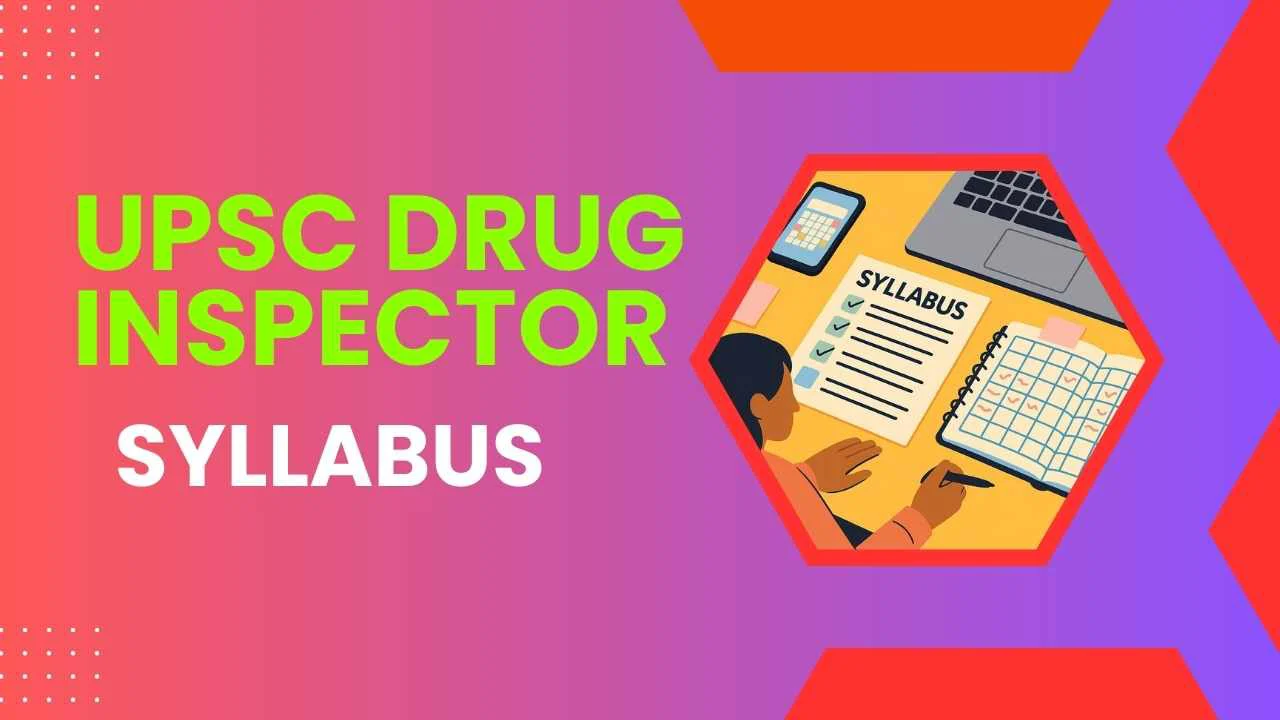
UPSC Drug Inspector Syllabus 2026: The Union Public Service Commission (UPSC) demands a rigorous depth of knowledge, particularly in regulatory affairs and forensic pharmacy, distinguishing it from other pharmaceutical entrance exams. Whether you are targeting the anticipated vacancies under the Central Drugs Standard Control Organization (CDSCO) or State-level deputations, the syllabus remains the blueprint for your success. Below is the detailed, topic-wise syllabus and exam pattern based on the latest official guidelines to help you navigate this high-stakes examination.
UPSC Drug Inspector Exam 2026 Summary
UPSC Drug Inspector Syllabus 2026: With the UPSC Drug Inspector recruitment cycle gaining momentum for the 2026 period, aspirants must align their preparation with the officially prescribed curriculum. The Union Public Service Commission (UPSC) requires a rigorous depth of knowledge, particularly in regulatory affairs and forensic pharmacy, which distinguishes it from other pharmaceutical entrance exams.
| Exam Authority | Union Public Service Commission (UPSC) |
| Department | Central Drugs Standard Control Organization (CDSCO) |
| Post Name | Drug Inspector (Medical Devices / General) |
| Selection Process | Recruitment Test (RT) + Interview |
| Exam Duration | 2 Hours (120 Minutes) |
| Total Marks | 300 Marks (75:25 Weightage for Final Selection) |
| Official Website | [suspicious link removed] |
UPSC Drug Inspector Selection Criteria
The selection process is strictly merit-based, designed to filter candidates with both theoretical brilliance and practical regulatory insight.
- Stage 1 – Written Recruitment Test (RT): A Pen & Paper based offline exam consisting of objective questions. It serves as the primary screening stage.
- Stage 2 – Interview: Candidates shortlisted from the RT face a Personality Test/Interview (100 Marks).
- Final Merit: The final rank is determined by a combined score of the Recruitment Test and Interview in a 75:25 ratio.
UPSC Drug Inspector Exam Pattern 2026
The exam pattern focuses on speed and precision. Unlike university exams, the emphasis here is on application-based knowledge of drug laws and manufacturing defects.
| Exam Mode | Subject | Questions | Marks | Duration |
| Offline (OMR) | Subject Specific: Pharmaceutical Sciences General: General Knowledge & Science | Mixed (approx. 100-120) | 300 | 2 Hours |
Note on Marking:
Negative Marking: There is a penalty of 1/3rd marks for every incorrect answer.
Standard: The level of the paper is generally that of a Bachelor’s Degree in Pharmacy.
UPSC Drug Inspector Detailed Topic-Wise Syllabus
The syllabus is vast and can be broadly categorized into eight core modules. The “Forensic Pharmacy” module is the most critical for this specific job role.
| Module | Topics Covered |
| 1. Forensic Pharmacy (Drug Laws) | • Drugs and Cosmetics Act, 1940 & Rules 1945 (Schedules, Forms, Licensing) • Pharmacy Act, 1948 • Medical & Toilet Preparation Act, 1955 • Narcotic Drugs & Psychotropic Substances Act (NDPS), 1985 • Drugs Price Control Order (DPCO), 1995 • Medical Devices Rules, 2017 |
| 2. Manufacturing Pharmacy | • Tablet & Capsule: Formulation, Granulation, Coating defects, Evaluation parameters. • Parenterals: Sterility testing, Pyrogens, WFI (Water for Injection) standards. • Liquid Dosage: Emulsions, Suspensions, Ointments, and Creams. • Blood Products: Storage, Handling, and Regulatory requirements. |
| 3. Pharmaceutical Analysis | • Spectroscopy: UV-Visible, IR, NMR, Mass Spectrometry (Principles & Application). • Chromatography: HPLC, GLC, TLC, Paper Chromatography. • Titrimetry: Acid-base, Redox, Complexometric, Karl Fischer Titration. • Microbiological Assays: Assay of Vitamins & Antibiotics. |
| 4. Medicinal Chemistry | • Structure, Storage & Synthesis of: Steroids, Antihistamines, Sedatives, Hypnotics, Psychotherapeutic agents, Analgesics, Cardiovascular agents. • Brand Names & Generic Names correlation. |
| 5. Pharmacognosy | • Sources & Chemical Constituents: Alkaloids (Rauwolfia, Cinchona, Opium), Glycosides (Senna, Digitalis), Terpenoids. • Adulteration: Detection of adulterants in natural drugs. • Microscopy: Basic identification of crude drugs. |
| 6. Pharmacology & Toxicology | • General: ADME (Absorption, Distribution, Metabolism, Excretion), Bioavailability. • Systemic Pharmacology: Drugs acting on CNS, CVS, GIT, and Respiratory systems. • Toxicology: Drug interactions, Adverse Drug Reactions (ADR), Drug dependence. |
| 7. Hospital & Clinical Pharmacy | • Prescription: Handling, Reading, and Incompatibilities (Physical, Chemical, Therapeutic). • Clinical: Common daily terminologies, Patient counseling, Storage conditions. |
| 8. General Knowledge | • Current Events (National & International), Indian Constitution (Polity), General Science, and basic Geography. |