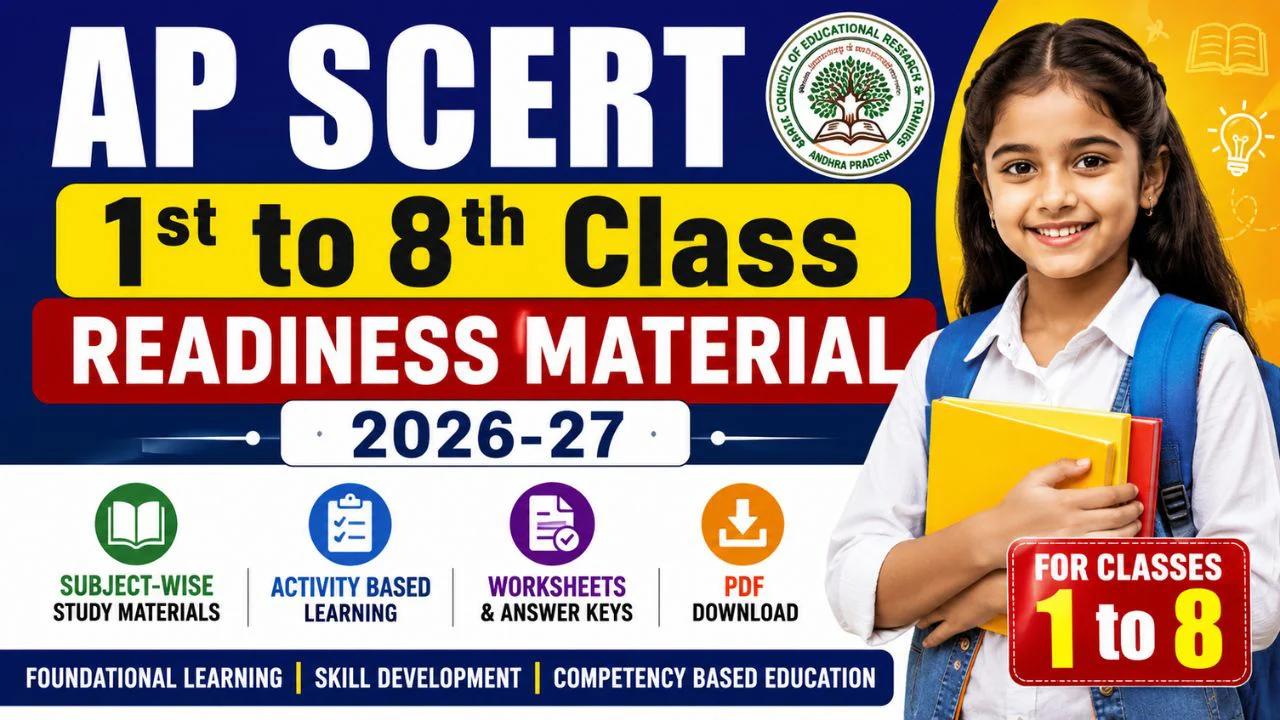
The Andhra Pradesh State Council of Educational Research and Training (AP SCERT) has designed the 1st to 8th Class Readiness Material for the 2026-27 academic year. This specialized school readiness program is launched at the start of the academic session to address existing learning gaps and ensure a seamless transition for students entering new grades. Following a long summer break, students often require a structured, engaging, and supportive bridging phase before they are introduced to the rigorous standard curriculum.
The AP SCERT readiness modules are designed to revitalize foundational literacy and numeracy (FLN) skills, cultivate a positive learning environment, and assess children’s baseline competencies. By combining play-based pedagogy for primary classes with conceptual brush-ups for upper primary classes, this program sets the stage for a productive and successful academic year.
AP SCERT Readiness Program 2026-27
Before delving into the specific class-wise modules, it is important to understand the fundamental framework of the AP SCERT readiness initiative.
| Program Name | AP SCERT School Readiness Programme 2026-27 |
| Conducting Authority | Andhra Pradesh State Council of Educational Research and Training |
| Target Classes | Class 1 to Class 8 (Primary and Upper Primary) |
| Academic Year | 2026-2027 |
| Duration of Program | 30 to 45 Days (at the start of the academic year) |
| Material Provided | Teacher Handbooks, Student Workbooks, Activity Sheets |
| Key Focus Area | Foundational Literacy & Numeracy (FLN) and Bridging Learning Gaps |
| Official Website | ap.gov.in / SCERT AP portal |
Core Objectives of the Readiness Material
The readiness program focuses on improving students’ understanding of basic concepts in languages, mathematics, science, and social studies. The study materials include engaging activities, worksheets, practice exercises, and answer keys that help bridge learning gaps and ensure a smooth transition into the new academic year.
The readiness material is not merely a revision of the previous year’s syllabus; it is a scientifically designed pedagogical tool. The primary objectives include:
Bridging Learning Deficits: To recover any learning loss from the previous academic year and ensure all students are at the appropriate learning level before starting the new curriculum.
Strengthening Foundational Skills: To focus heavily on reading, writing, and basic mathematical operations, aligning with the goals of the National Education Policy (NEP) 2020.
Promoting Activity-Based Learning: To shift the focus from rote memorization to experiential learning through games, storytelling, and interactive worksheets.
Reducing Academic Anxiety: To provide a stress-free, welcoming environment for students returning to school, helping them acclimatize to the classroom routine.
Class-wise Structure of the Readiness Program
The readiness program is thoughtfully divided into different pedagogical stages to cater to the cognitive development of children across various age groups.
Primary Level (Classes 1 and 2)
For the youngest learners, the focus is entirely on familiarization, sensory-motor skills, and early language acquisition. The material includes tracing exercises, picture reading, alphabet and number recognition games, and rhymes. The goal is to make the school environment inviting and to develop basic phonemic awareness and number sense up to 20.
Preparatory Level (Classes 3 to 5)
At this stage, the readiness module bridges the transition from simple recognition to application. Students are introduced to reading short comprehension passages, writing simple sentences, and solving basic arithmetic problems involving addition, subtraction, multiplication, and simple division. Environmental Science (EVS) activities are integrated to promote observation of their immediate surroundings.
Upper Primary Level (Classes 6 to 8)
For upper primary students, the readiness material is subject-specific, targeting core concepts in Languages, Mathematics, Science, and Social Studies. The modules aim to reinforce prior critical learning outcomes. For instance, in Mathematics, the focus is on fractions, decimals, and basic geometry, ensuring students have the prerequisite knowledge for advanced middle-school concepts.