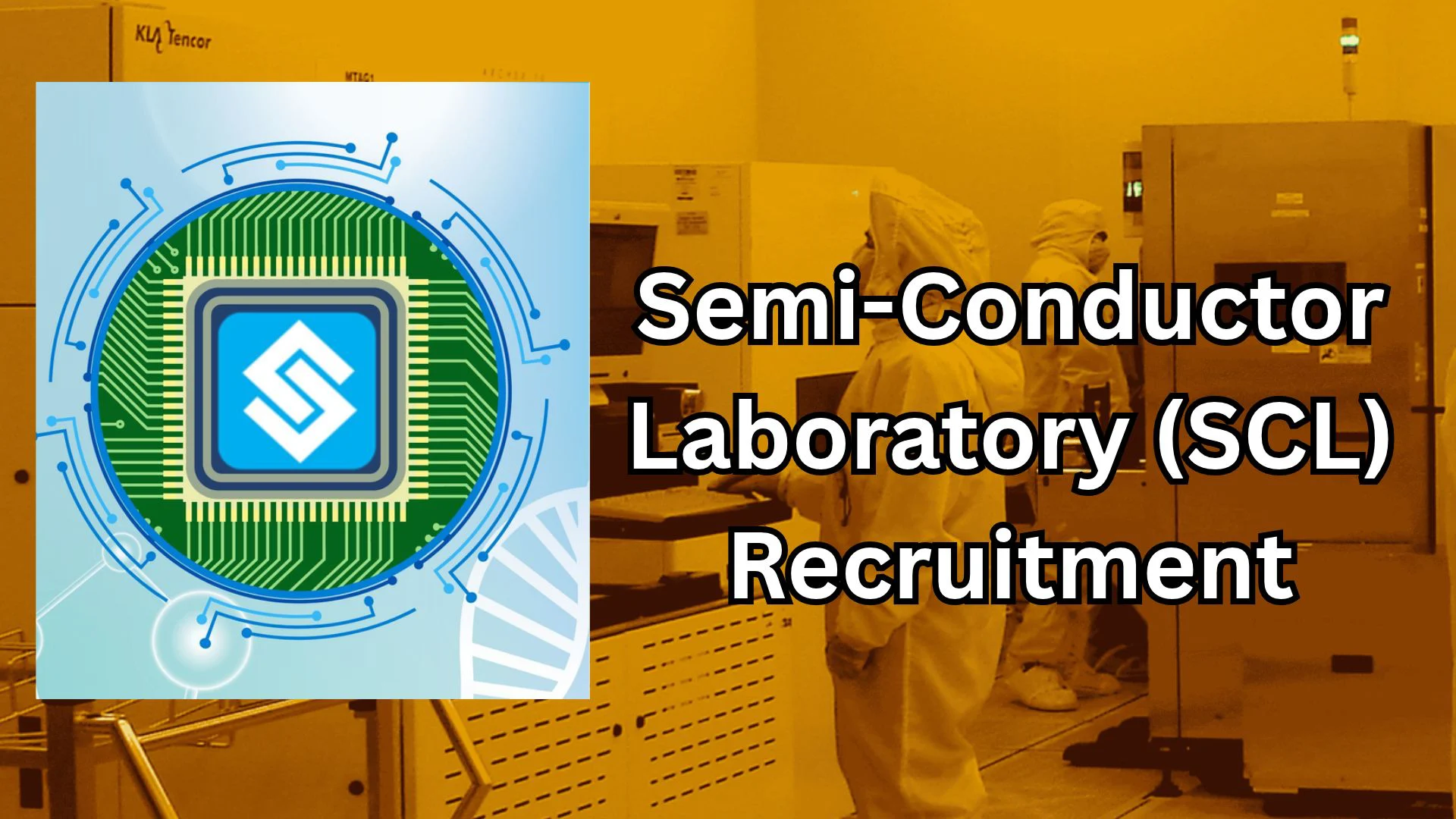
The Semi-Conductor Laboratory (SCL) has released the detailed syllabus and examination pattern for recent recruitment drive, targeting 83 vacancies across Administrative Officer, Accounts Officer, Purchase & Stores Officer, Junior Personal Assistant (JPA), Technical Assistant, and Technician ‘B’ roles. A thorough understanding of the Computer Based Test (CBT) structure, negative marking scheme, and topic-wise weightage is essential for candidates aiming to secure a position at this premier MeitY institution.
SCL Recruitment 2026 Syllabus & Exam Pattern Overview
| Organization Name | Semi-Conductor Laboratory (SCL) |
| Advertisement Number | SCL:DR:01/2026 |
| Post Names | Admin Officer, Accounts Officer, Purchase Officer, JPA, Technical Assistant, Technician ‘B’ |
| Mode of Examination | Computer Based Test (CBT) |
| Type of Questions | Objective Type – Multiple Choice Questions (MCQs) |
| Official Website | www.scl.gov.in |
Selection Criteria
The selection process varies strictly according to the cadre and post applied for:
Administrative, Accounts, and Purchase & Stores Officers: Candidates will be evaluated through a Computer Based Test (CBT) followed by a Personal Interview. The final merit list assigns a 60% weightage to the CBT and 40% to the interview.
Junior Personal Assistant (JPA): The selection consists of a CBT and a Stenography Skill Test. The Skill Test is purely qualifying, meaning final selection relies entirely on CBT scores.
Technical Assistant & Technician ‘B’: Candidates must clear the CBT and a subsequent Trade-specific Skill Test. The Skill Test operates on a strict ‘go-no-go’ (qualifying) basis, with final merit determined exclusively by CBT marks.
SCL CBT Exam Pattern 2026
The Computer Based Test is divided into two parts for Administrative and Technical roles (Part A and Part B), while the JPA exam consists only of Part A. Candidates will be awarded 1 mark for every correct answer, and there is a negative marking of 0.25 marks for every incorrect answer across all exams.
| Part | Subject | Questions | Marks | Duration |
| Part-A | General English | 25 | 25 | 60 Minutes |
| Quantitative Aptitude | 25 | 25 | ||
| General Intelligence and Logical Ability | 25 | 25 | ||
| General Knowledge/Current Affairs | 25 | 25 | ||
| Part-B | Curriculum / Trade-Based Test | 100 | 100 | 60 Minutes |
(Note: The JPA post exam comprises only Part-A for 100 marks in 60 minutes).
Topic-wise Detailed Syllabus
The syllabus is meticulously structured to test a candidate’s foundational aptitude and specialized domain knowledge. Part A is common across most posts, testing general awareness, analytical ability, and language proficiency, while Part B strictly assesses curriculum or trade-specific expertise.
| Subject | Detailed Topics |
| General Intelligence & Logical Ability | Analogies, similarities and differences, space visualization, spatial orientation, problem-solving, analysis, judgment, decision making, visual memory, relationship concepts, arithmetical reasoning, number series, coding-decoding, syllogistic reasoning, Venn diagrams, and emotional/social intelligence. |
| General Knowledge / Current Affairs | Current events, environmental awareness, India and neighboring countries, History, Culture, Geography, Economic Scene, General Policy, and Scientific Research. |
| Quantitative Aptitude | Whole numbers, decimals, fractions, percentage, ratio & proportion, square roots, averages, interest, profit and loss, discount, time and distance, time & work, basic algebra, geometry (triangles, circles, quadrilaterals), trigonometry, and statistical charts (histogram, bar diagram, pie chart). |
| General English | Vocabulary, grammar, sentence structure, synonyms, antonyms, spot the error, fill in the blanks, idioms & phrases, one-word substitution, active/passive voice, direct/indirect narration, cloze passage, and reading comprehension. |
| Part B: Administrative / Accounts / Purchase | Admin: HR Management, Office Procedures, Govt Rules (CCS, Leave, Pension), Constitution, Labour Codes, RTI. Accounts: Financial Accounting, Auditing, Costing, Taxation (GST, TDS), Economics. Purchase: Procurement, GeM, Vendor Management, Inventory, Contract Act. |
| Part B: Technical Assistant & Technician ‘B’ | TA: Degree/Diploma level engineering concepts specific to the applied discipline (e.g., Electrical, Mechanical, Electronics, CS, IT, Chemical, Physics, Chemistry). Tech ‘B’: ITI-level curriculum covering practical and theoretical concepts of the applied trade (e.g., Fitter, Electrician, Electronics Mechanic, Draughtsman, R&AC). |
Preparation Tips
Master the Negative Marking: With a 0.25 penalty for wrong answers, guessing can severely impact your score. Focus on accuracy rather than attempting every question.
Balance Part A and Part B: While technical/domain knowledge carries 100 marks, the general aptitude section also carries 100 marks. Allocate equal study time to quantitative aptitude and logical reasoning to maximize your overall score.
Focus on Trade Basics (For Technical Posts): The skill test is purely qualifying on a ‘go-no-go’ basis. Prioritize theoretical clarity for the CBT and brush up on practical workshop safety and tool operations for the skill assessment.
Review Official Government Rules (For Admin Posts): Group A candidates should thoroughly study the General Financial Rules (GFR) 2017, the Right to Information Act 2005, and various CCS conduct and pension rules, as these form the core of the Part B assessment.