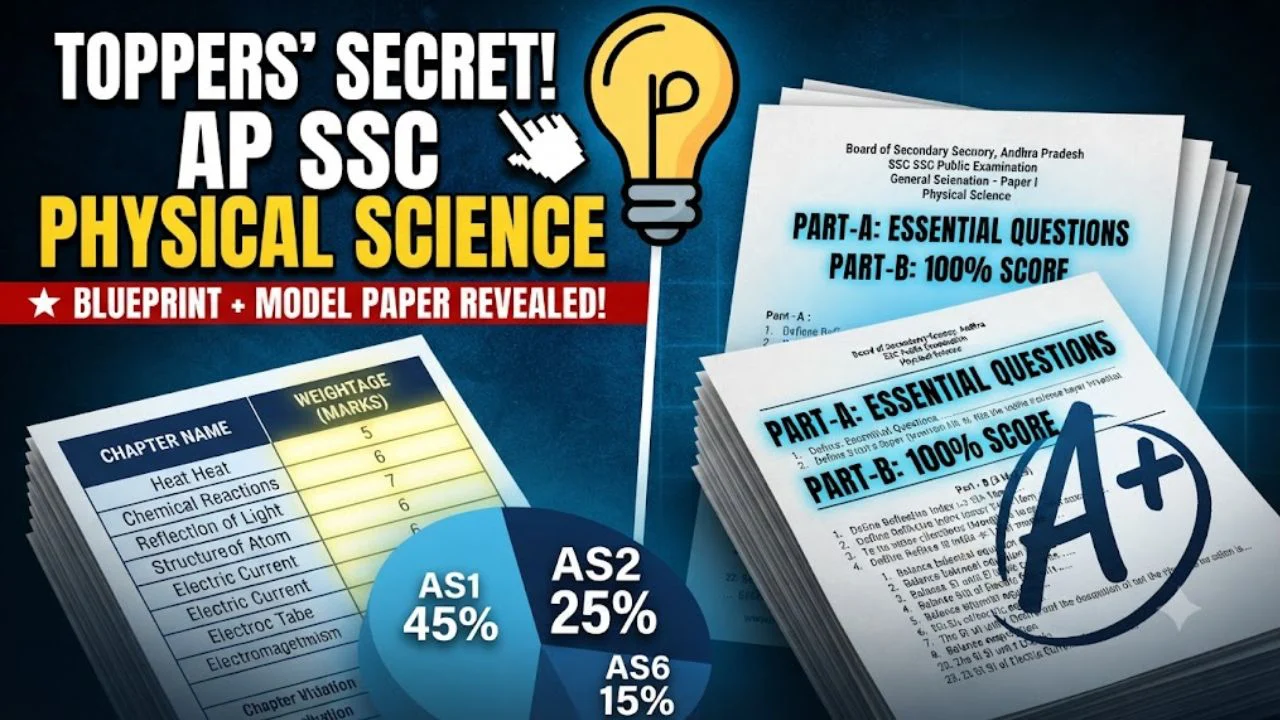
BSE AP (Board of Secondary Education, Andhra Pradesh) has released the complete blueprint for the General Science Paper-I Examination (Physical Science) for the academic year 2026-27.

AP 10th Class (GS-1) Physics Exam: Major Changes from 2026 Paper
- Chapter-wise Weightage has not changed
| Topic | 2026 | 2027 |
| Competency-Based Evaluation | Knowledge (20%), Understanding (25%), Application (20%), Analysis (15%), Evaluation (10%), and Creation (10%). | Awareness (60%), Sensitivity (20%), and Creativity (20%) |
AP 10th Class Physics Blueprint 2027: Weightage to Objective Design
The objective design assigns specific mark distributions based on awareness, sensitivity, and creativity.
| Objective | % of Marks | Marks |
Awareness | 60% | 30 |
Sensitivity | 20% | 10 |
Creativity | 20% | 10 |
Weightage to Form of Question
This table breaks down the types of questions, marks allotted, and estimated time.
| Forms of Questions | No. of Questions | Marks Allotted | Estimated Time (min) |
E/LA (8M) | 3 | 24 | 60 |
SA (4M) | 3 | 12 | 30 |
VSA (2M) | 3 | 6 | 15 |
O (MCQ) – 1 Mark Qns | 8 | 8 | 15 |
Total | 17 | 50 | 120 (Including 15 min for Reading) |
Estimated Difficulty Level
The difficulty breakdown ensures a balanced paper for all students.
| Difficulty Level | Estimated Marks Percentage |
Easy | 40% Marks |
Average | 45% Marks |
Difficult | 15% Marks |
AP 10th Class Physics Blueprint 2027: Chapter-wise Marks & Question Distribution
Based on the official blueprint design, here is the chapter-wise analysis showing the total marks allotted, the specific question breakup, and the number of questions asked from each chapter (including internal choices).
Highest Weightage Chapters (11 Marks each): Carbon and its Compounds, Light—Reflection and Refraction, and Electricity.
Highest Number of Questions (4 Questions each): Acids, Bases and Salts and Light—Reflection and Refraction yield the highest density of individual items on the paper.
Lowest Question Count: Magnetic Effects of Electric Current only features a single 8-mark essay option.
| S.No. | Chapter / Unit Name | Marks Allotted | No. of Questions | Specific Question Breakup (Marks) PDF |
| 1 | Chemical Reactions and Equations | 9 M | 2 | 1 MCQ (1M) + 1 Long Answer (8M) |
| 2 | Acids, Bases and Salts | 10 M | 4 | 2 MCQs (1M each) + 1 Medium Diagram (4M) + 1 Short Answer (4M) |
| 3 | Metals and Non-Metals | 9 M | 2 | 1 MCQ (1M) + 1 Long Answer (8M) |
| 4 | Carbon and its Compounds | 11 M | 3 | 1 MCQ (1M) + 1 Short Answer (2M) + 1 Long Answer (8M) |
| 5 | Light—Reflection and Refraction | 11 M | 4 | 1 MCQ (1M) + 1 Short Answer (2M) + 1 Medium Diagram (4M) + 1 Short Answer (4M) |
| 6 | The Human Eye and Colourful World | 9 M | 2 | 1 MCQ (1M) + 1 Long Answer (8M) |
| 7 | Electricity | 11 M | 3 | 1 MCQ (1M) + 1 Short Answer (2M) + 1 Long Answer (8M) |
| 8 | Magnetic Effects of Electric Current | 8 M | 1 | 1 Long Answer (8M) |
| TOTAL | 78 M (50M + 28M Choice) | 21 Questions (consisting of 17 Question Numbers) | ||
Question-Wise Analysis of AP 10th Physics Blueprint
Here is the question-by-question analysis, broken down by section, question number, chapter, assigned student ability, and question format.
SECTION-I (8 Questions X 1 Mark = 8 Marks)
Format: Very Short Answer / Multiple Choice (1 Mark each)
Options: Answer all questions (No internal choice)
| Q.No. | Chapter / Topic | Ability Evaluated | Question Focus / Type |
1 | Chemical Reactions and Equations | Sensitivity | Application of rancidity prevention in everyday food preparation. |
2 | Acids, Bases and Salts | Creativity | Formulating a method to neutralize a specific pH solution. |
3 | Acids, Bases and Salts | Sensitivity | Identifying correct safe peer practices for acid dilution in a lab. |
4 | Metals and Non-Metals | Sensitivity | Formulating a polite question to guide a peer out of a misconception. |
5 | Carbon and its Compounds | Awareness | Direct factual knowledge (Identification of Acetic acid solution/Covalent bonds). |
6 | Light—Reflection and Refraction | Sensitivity | Analyzing peer statements regarding real-world mirror applications. |
7 | The Human Eye & Colourful World | Awareness | Core knowledge regarding light deviation through a prism / atmospheric phenomena. |
8 | Electricity | Creativity | Explaining the logic behind material choices in electrical components. |
SECTION-II (3 Questions X 2 Marks = 6 Marks)
Format: Short Answer (2 Marks each)
Options: Answer all questions (No internal choice)
| Q.No. | Chapter / Topic | Ability Evaluated | Question Focus / Type |
9 | Carbon and its Compounds | Creativity | Structural identification (Drawing isomers or identifying allotropes). |
10 | Light—Reflection and Refraction | Sensitivity | Devising two probing questions to clear up a classmate’s misconception. |
11 | Electricity | Creativity | Technical execution (Designing a series circuit diagram or a current control mechanism). |
SECTION-III (3 Questions X 4 Marks = 12 Marks)
Format: Medium Answer / Diagrammatic (4 Marks each)
Options: Internal choice available only for Question 12.
| Q.No. | Chapter / Topic | Ability Evaluated | Question Focus / Type |
12 A | Light—Reflection and Refraction | Awareness | Diagram Question: Drawing specific ray diagrams for lenses or mirrors. |
12 B | Acids, Bases and Salts | Awareness | Diagram Question: Drawing experimental setups (Chlor-alkali / Zinc granule reaction). |
13 | Acids, Bases and Salts | Sensitivity | Analyzing a peer debate over salt applications and correcting errors. |
14 | Light—Reflection and Refraction | Creativity | Context-shifting matrix/scenarios determining object movement for specific lens/mirror outcomes. |
SECTION-IV (3 Questions X 8 Marks = 24 Marks)
Format: Essay / Long Answer (8 Marks each)
Options: Full Internal Choice (Each number has an “A” or “B” option).
| Q.No. | Chapter / Topic | Ability Evaluated | Question Focus / Type |
15 A | The Human Eye & Colourful World | Awareness | Comprehensive explanation of eye defects (Myopia/Hypermetropia) with diagrams. |
15 B | Electricity | Awareness | Deriving foundational laws (Ohm’s law definitions / Series resistance formula $R_s$). |
16 A | Chemical Reactions and Equations | Awareness | Comprehensive balancing of equations or explanation of the 4 reaction types. |
16 B | Carbon and its Compounds | Awareness | Completing structural classification tables (Alkanes/Alkenes) or explaining soap mechanism. |
17 A | Magnetic Effects of Electric Current | Awareness | Detailed lab activity report (Oersted’s experiment / force on current-carrying conductor). |
17 B | Metals and Non-Metals | Awareness | Detailed lab activity report (Metal reactivity displacement/heat conductivity of metals). |