
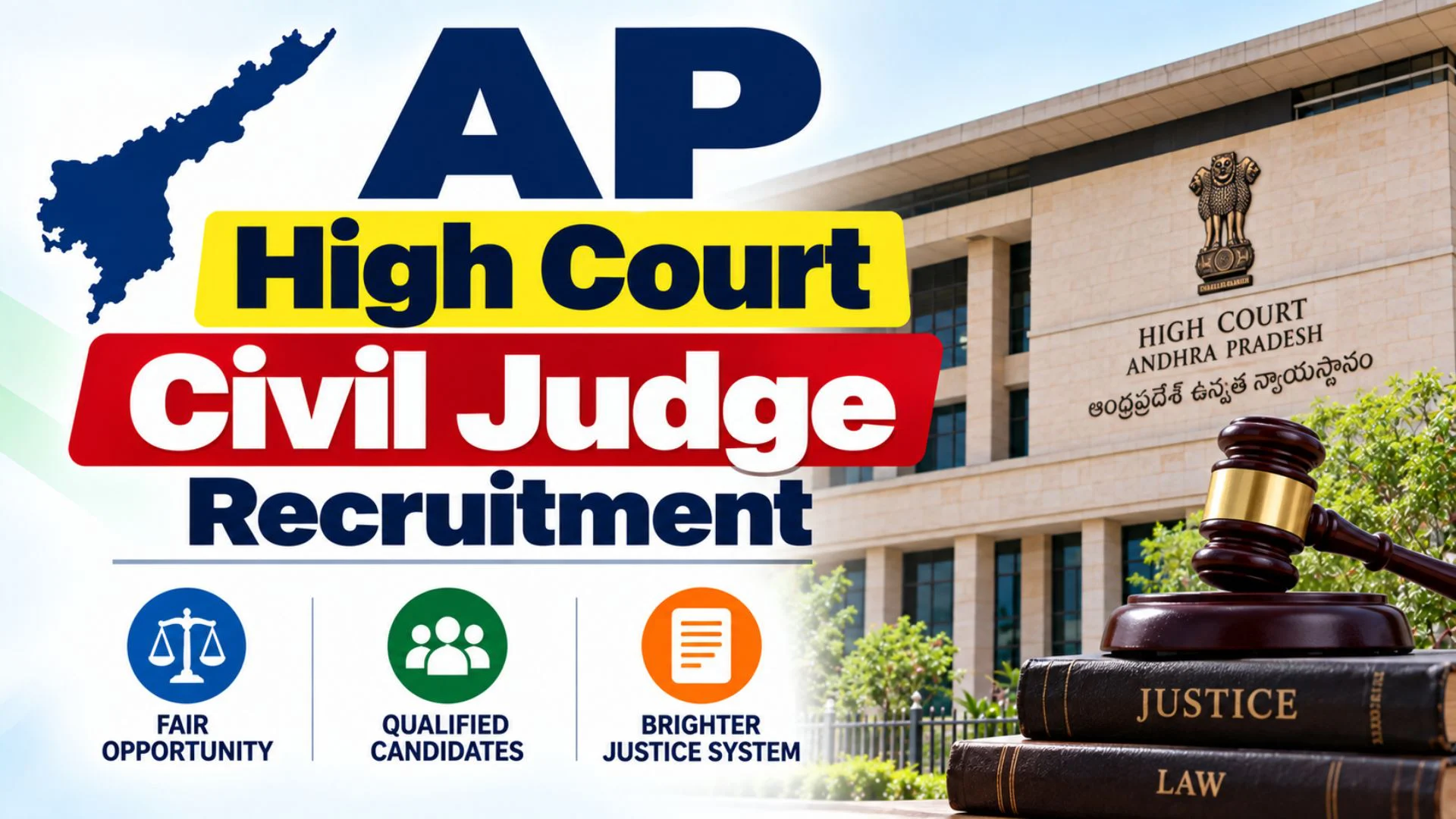
AP High Court Civil Judge Syllabus 2026: The Andhra Pradesh High Court Civil Judge (Junior Division) examination is a highly competitive opportunity for law graduates aspiring to build a career in the state’s judicial services. Candidates must be thoroughly familiar with the official syllabus and examination structure to navigate the rigorous selection process, which evaluates legal acumen, translation proficiency, and overall judicial aptitude. The official syllabus comprises core Civil Laws and Criminal Laws, which remain common across both the preliminary screening test and the mains written examination, ensuring a comprehensive assessment of a candidate’s legal foundation.
AP High Court Civil Judge Syllabus 2026: Highlights
| Organization | High Court of Andhra Pradesh |
| Post Name | Civil Judge (Junior Division) |
| Selection Process | Screening Test, Mains Written Exam, Viva Voce |
| Language of Exam | English (with Telugu used for the translation paper) |
| Qualifying Criteria (Mains Paper III) | 40% minimum marks required |
| Official Website | hc.ap.nic.in |
AP High Court Civil Judge Selection Process 2026
The AP High Court Civil Judge recruitment is conducted in three distinct stages, each designed to filter candidates based on different competencies:
Screening Test: A computer-based test (CBT) consisting of objective-type multiple-choice questions used primarily to shortlist candidates for the next round.
Mains Examination: A descriptive, offline written test divided into three papers covering Civil Laws, Criminal Laws, and a dedicated language proficiency paper focusing on legal essay writing and translation.
Viva-Voce: A personal interview round carrying 50 marks that assesses the candidate’s ethical integrity, communication skills, balance of judgment, and mental alertness.
AP High Court Civil Judge Exam Pattern 2026
The examination pattern is structured to test foundational legal knowledge under time constraints during the screening phase, followed by in-depth conceptual clarity and drafting skills in the mains. The screening test acts as a qualifying barrier, whereas the descriptive written exams dictate the core scoring for final merit. Notably, Paper III in the mains is a crucial qualifier where candidates must secure a minimum of 40% to remain eligible for the viva-voce.
- The Screening Test is Objective Multiple Choice Questions.
- It Contains 100 Questions. Wach Question carries one Mark.
- The Total Marks are
- The Duration of Time is 2 Hours.
| Exam Stage | Subject / Paper | Mode | Marks | Duration |
| Screening Test | Civil & Criminal Laws | CBT (Objective) | 100 | 2 Hours |
| Mains – Paper I | Civil Laws | Descriptive (Offline) | 100 | 3 Hours |
| Mains – Paper II | Criminal Laws | Descriptive (Offline) | 100 | 3 Hours |
| Mains – Paper III | English Translation (25) & Legal Essay (75) | Descriptive (Offline) | 100 | 3 Hours |
AP High Court Civil Judge Syllabus 2026
The syllabus for the AP High Court Civil Judge exam is deeply rooted in core Indian legal statutes, specialized local Andhra Pradesh acts, and day-to-day procedural rules utilized in courts. There is no distinct separation between the preliminary and mains syllabi; the exact same list of legislative acts applies to both stages.
| Subject Category | Key Topics / Acts Covered |
| Civil Laws | Code of Civil Procedure (1908), Indian Contract Act (1872), Hindu Marriage Act (1955), Hindu Succession Act (1956), Specific Relief Act (1963), Transfer of Property Act (1882), Limitation Act (1963), Indian Easements Act (1882), Registration Act (1908), Indian Stamp Act (1899), AP Land Encroachment Act (1905), Civil Rules of Practice, Indian Evidence Act (1872). |
| Criminal Laws | Code of Criminal Procedure (1973), Indian Penal Code (1860), Indian Evidence Act (1872), Negotiable Instruments Act (1881), Protection of Women from Domestic Violence Act (2005), Juvenile Justice (Care and Protection of Children) Act (2015), AP Excise Act (1968), AP Gaming Act (1974), Criminal Rules of Practice. |
CIVIL LAWS:
- The Code of Civil Procedure, 1908
- The Indian Contract Act, 1872
- The Hindu Marriage Act, 1955
- The Hindu Succession Act, 1956
- The Indian Easements Act, 1882
- The Specific Relief Act, 1963
- The Limitation Act, 1963
- The Transfer of Property Act, 1882
- The Civil Rules of Practice
- The Registration Act, 1908, and the Indian Stamp Act, 1899
- The A.P. Land Encroachment Act, 1905
- The Indian Evidence Act, 1872
CRIMINAL LAWS:
- The Code of Criminal Procedure, 1973
- The Indian Penal Code, 1860
- The Indian Evidence Act, 1872
- The Negotiable Instruments Act, 1881
- The Protection of Women from Domestic Violence Act, 2005
- The Criminal Rules of Practice
- The A.P. Excise Act, 1968
- The A.P. Gaming Act, 1974
- The Juvenile Justice (Care and Protection of Children) Act, 2015.