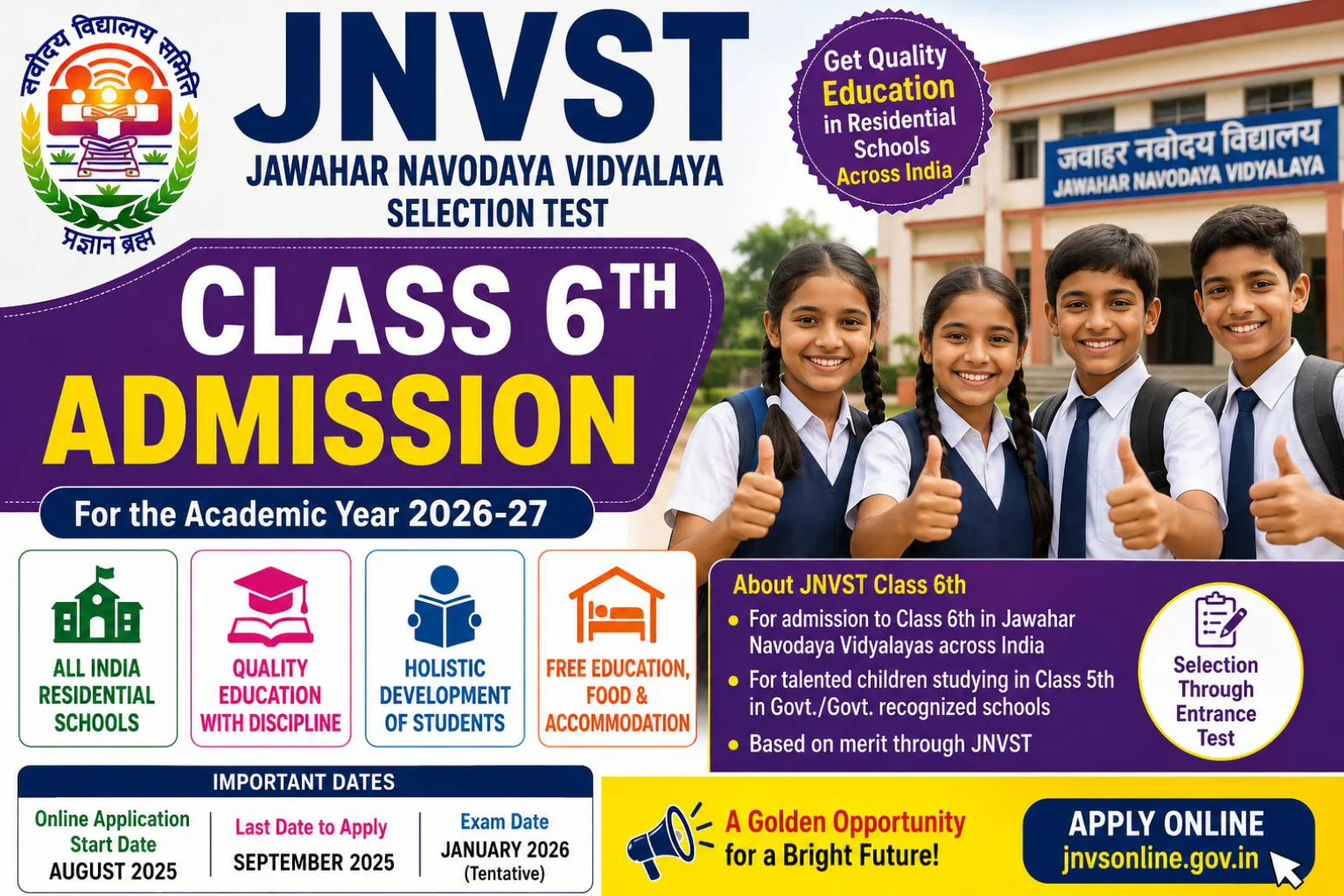
Navodaya JNVST Class 6 Admission Online Form 2027-28: The Jawahar Navodaya Vidyalaya Samiti (JNVST) has released the Vidyalaya 6th Class Admission Notification for Academic Session 2027-28. At present, 654
Vidyalayas are functional in 27 States and 08 Union Territories. A maximum of 80 students are admitted to Class VI in each Vidyalaya through a Selection Test, subject to the availability of suitable candidates. Students interested in the Navodaya Vidyalaya Entrance Exam 2027 can register on the Official Website, i.e., navodaya.gov.in.
JNVST Class 6th Admission 2027-28: The Navodaya Vidyalaya Samiti (NVS), an autonomous organization under the Ministry of Education, Government of India, has officially released the Prospectus cum Notification for the Jawahar Navodaya Vidyalaya Selection Test (JNVST) 2027. This national-level entrance examination manages admissions to Class VI for the 2027-28 academic session across functional residential schools nationwide.
JNVs aim to uncover and nurture talented children, predominantly from rural areas, providing them with high-quality, modern, free education. Below is an updated, comprehensive guide featuring all newly revised structural, financial, and eligibility updates outlined in the official prospectus.
JNVST 2027 Entrance Test Class VI Admission -Important Dates
| Organization | JAWAHAR Navodaya Vidyalaya Samiti |
| Exam Name | JAWAHAR NAVODAYA VIDYALAYA SELECTION TEST 2027 |
| Academic Year | 2027-28 |
| Exam Type | National Level Entrance Test |
| Mode of Application | Online |
| Starting Date to Apply | 06 July 2026 |
| Ending Date to Apply | 29 July 2026 |
| Selection Procedure | Written Test |
| Admit Card Release Date | March/April 2027 |
| Exam Date | 28th November, 2026 |
| Official Website | navodaya.gov.in |
Note on Excluded Districts: The JNV scheme does not cover areas with 100% urban populations. Consequently, no JNVs are sanctioned in 6 specific districts: Central Delhi, New Delhi, Hyderabad, Kolkata, Mumbai, and Mumbai Sub-Urban.
The Navodaya Vidyalaya Entrance Test for Class 6 has started and will close on 31 July 2026.
- Last Date to Submit Online Application: July 31, 2026
- JNVST 2027 Exam Date: November 28, 2026 (Single-phase exam for both Summer-bound and Winter-bound JNVs)
- Expected Date of Result Declaration: End of March 2027
- Final Closing of Admissions: August 31, 2027
JNVST 2027: 6th Class-Eligibility Conditions
- The candidate has to study in Class V at any Government-recognized school located in the same District during 2026-27.
- A candidate appearing for the selection test must be studying in Class V for the entire academic session 2026-27 in a Government/Government aided or other recognized school. The candidate who has not been promoted and admitted to Class V before 31st July 2026 is not eligible to apply.
The candidate must reside in the district where he/she is seeking admission to the JNV located in the same District. A bona fide residence certificate for the parent is to be submitted at the time of document verification after provisional selection.
- Candidates must be born between 01-05-2015 and 31-07-2017 (both dates inclusive).
This constraint applies strictly to all student categories, including SC, ST, OBC, and Divyang candidates.
In rare scenarios involving doubtful age records, NVS will refer the student to a Medical Board, whose decision remains binding and final.
Selection Process & Reservation Rules
Sectional Cut-Offs: To be provisionally selected, students must secure the minimum qualifying marks in each individual segment: a minimum of 14 marks in Mental Ability & EVS, 7 marks in Arithmetic, and 7 marks in Language.
Rural Quota Allocation: At least 75% of the district’s seats are reserved for rural area candidates. To claim this, the candidate must have studied Classes III, IV, and V in a school officially notified as rural.
Urban Quota Allocation: The remaining open seats are assigned on pure merit. If a student has studied in an urban location for even a single day during Classes III, IV, or V, they are categorized as an urban candidate.
Category Reservations: Scheduled Castes (SC) receive a minimum of 15% and Scheduled Tribes (ST) a minimum of 7.5%, up to a combined maximum of 50%. Other Backward Classes (OBC) receive 27% reservation based on the Central List.
Gender Balance: Minimum one-third (1/3) of the total available seats are filled by girl candidates. Transgender candidates are grouped within the boys’ category for reservation purposes.
The Students who are selected in Navodaya Vidyalaya Entrance Test 2027 Conducted by JNVST Board are given below
- Residence Certificate in prescribed Performa in case of NIOS study only
- Date of Birth Certificate
- Proofs for eligibility as per the conditions of NVS.
- For candidates seeking admission under the rural quota, the parents will also have to submit a certificate to the effect that the child had studied in an Institution located in a notified rural area
- Other required documents
JNVST 2027 Class 6 Exam Pattern and Duration
The selection test will be of two-hour duration from 11:30 am to 01:30 pm and will have 3 sections with only objective-type questions. There are 80 questions in all for 100 marks.
| Test Type | Number of Questions | Marks | Duration< |
| Mental Ability Test | 40 | 50 | 60 min |
| Arithmetic Test | 20 | 25 | 30 min |
| Language Test | 20 | 25 | 30 min |
| Total | 80 | 100 | 2 hours |
A single test booklet comprising of all three sections will be given to each candidate. Additional time of 30 minutes will be allowed for “Divyang students” (differently-abled students)
Application Process for JNVST 6th Entrance Test Application Form 2027
The process for submission of application for JNV Selection Test has been simplified through online process. Registration can be done free of cost through the admission portal of NVS linked through navodaya.gov.in
- The JNVST 6th Class Application Process is done online which is very simple. All documents required for the JNV Entrance test like Eligibility, Residence, age, etc Verification will be done successfully through laid download procedure.
- The eligible candidates along with his /her parent/guardians may approach Common Service Centre along with a duly filled-in certificate from the Head Master of School where the candidate is studying in Class V. The format of certificate may be downloaded from Samiti website www.nvshq.org the sample of format is enclosed.
- The candidates from NIOS should `B’ certificate and residence should be in the same district where he / she is seeking admission.
- The application for JNV Selection Test 2027 is being processed through Common Service Centre of Ministry of IT, Govt. of India. Common Service Centre has a wider range with 2.6 lakh centres across the country virtually covering every village.
The following documents in soft form (JPG format of size between 10 to 100 kb) may be kept ready for registration:
- Photograph
- Signature of parent
- Signature of candidate
- Aadhaar details/ Residence certificate issued by competent Government authority.
Centre for Examination
Each candidate shall appear for the selection test at the examination center allotted to him/her as indicated on the Admit Card. No candidate is permitted to appear from any other center. No request for change of center will be entertained. No candidate can appear in the selection test without proper Admit Card.
Language of the Examination
Jawahar Navodaya Vidyalaya Selection Test is conducted in various languages state wise as given below:
| Name of the State/UT | Languages |
| ANDAMAN & NICOBAR ISLANDS | Hindi, English, Tamil, Urdu, Bengali |
| ANDHRA PRADESH | Hindi, English, Telugu, Marathi, Urdu, Oriya, Kannada |
| ARUNACHAL PRADESH | English, Hindi |
| ASSAM | English, Hindi, Assamese, Bodo, Garo, Bengali, Manipuri(Bangla Script), Manipuri (Meitei Mayek) |
| BIHAR | English, Hindi, Urdu |
| CHANDIGARH | English, Hindi, Punjabi |
| CHHATTISGARH | English, Hindi |
| DELHI | English, Hindi |
| GOA | English, Hindi, Marathi, Kannada |
| GUJARAT | English, Hindi, Gujarati, Marathi |
| HARYANA | English, Hindi |
| HIMACHAL PRADESH | English, Hindi |
| JAMMU AND KASHMIR | English, Hindi, Urdu |
| JHARKHAND | English, Hindi, Urdu, Oriya |
| KARNATAKA | Hindi, English, Kannada, Telugu, Marathi, Urdu, Malayalam, Tamil |
| KERALA | Hindi, English, Malayalam, Tamil, Kannada |
| LAKSHADWEEP | Hindi, English, Malayalam |
| MADHYA PRADESH | English, Hindi, Urdu, Marathi, Gujarati |
| MAHARASHTRA | English, Hindi, Kannada, Marathi, Urdu, Telugu, Gujarati, Bengali |
| MANIPUR | English, Hindi, Manipuri (Meitei Mayek) |
| MEGHALAYA | English, Hindi, Khasi, Garo, Bengali, Assamese |
| MIZORAM | English, Hindi, Mizo |
| NAGALAND | English, Hindi |
| ODISHA | English, Hindi, Telugu, Oriya, Urdu |
| PUDUCHERRY | English, Tamil, Telugu, Malayalam, Hindi |
| PUNJAB | English, Hindi, Punjabi |
| RAJASTHAN | English, Hindi |
| SIKKIM | English, Hindi, Nepali |
| TELANGANA | Hindi, English, Telugu, Kannada, Marathi, Urdu |
| TRIPURA | English, Hindi, Bengali |
| UT LADAKH | English, Hindi, Urdu |
| UT OF DADAR & NAGAR HAVELI AND DAMAN AND DIU | English, Hindi, Gujarati, Marathi |
| UTTAR PRADESH | English, Hindi, Urdu |
| UTTARAKHAND | English, Hindi, Urdu |
| WEST BENGAL | English, Hindi, Bengali, Nepali, Urdu |