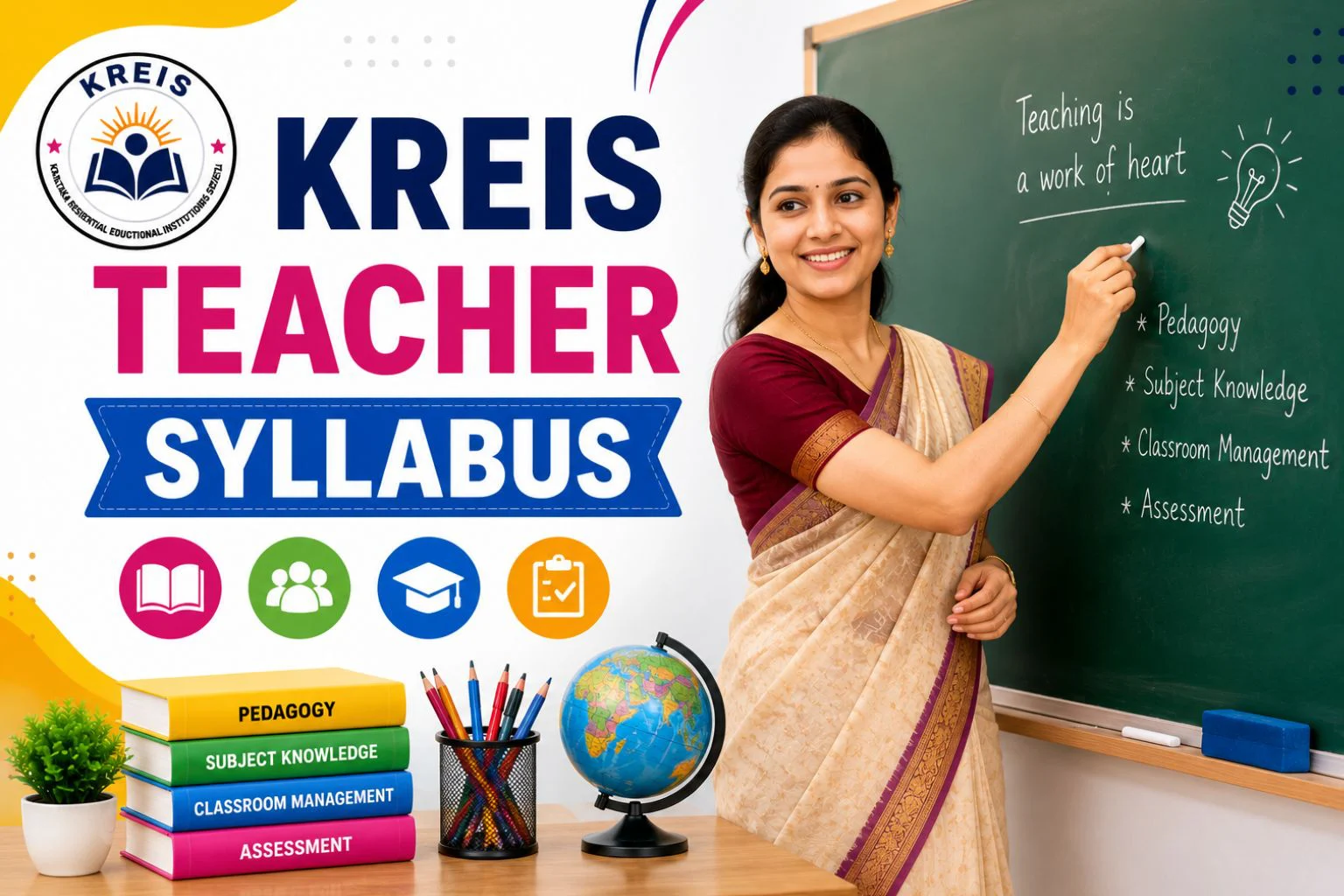
The Karnataka Residential Educational Institutions Society (KREIS) prescribes a comprehensive syllabus for recruitment to positions across Morarji Desai, Kittur Rani Chennamma, and Ekalavya Model Residential Schools. The examination structure is divided into specific papers targeting core competencies, general knowledge, educational administration, and optional subject specialization.
KREIS Principal Exam Syllabus and Paper Scheme
The syllabus for the post of Principal is structured across three distinct evaluation papers:
Paper 1: General Studies Syllabus
This paper consists of objective-type Multiple Choice Questions (MCQs) designed to evaluate basic mental and language skills:
Core Domains: General Awareness, General Intelligence and Reasoning, Numerical Ability, Mental Ability, Teaching Aptitude, General English, General Kannada, and General Knowledge.
Language Standards: The General English and General Kannada sections conform to the minimum standards expected of a university graduate, testing grammar, vocabulary, spelling, synonyms, comprehension, and usage.
General Knowledge Topics: Famous Books and Authors, Important Inventions & Discoveries, Basic Science and Scientific Phenomena, Human Hygiene and Physiology, Chronology of World History, Glimpses of Indian History, Basic Geographical Terms (Population, Literacy, Natural Regions/Resources, Crops, Major Industries), Indian Art and recognized Artists, National Policy on Education, Constitution of India (Union & State Government structures), and Current National & International Affairs.
Paper 2: Education 1 Syllabus
This section evaluates pedagogical administration, child psychology, and state-level educational measures:
Educational Administration: Constitutional provisions and directive principles for education, fundamental rights, democracy, secularism, social justice, the role of different agencies (society, home, school), classroom management, and the role of the Head of the Institution.
Psychological Foundations: Child development (physical, intellectual, emotional, and social), problems of adolescence, learning concepts, factors affecting learning, and motivation strategies.
New Initiatives in Karnataka: Quality Improvement Programmes, Compulsory Primary Education, incentive schemes (textbooks, uniforms, midday meals, residential schools), School Development and Monitoring Committees (SDMCs), examination systems, computer education, Sarva Shiksha Abhiyan (SSA), Rashtriya Madhyamik Shiksha Abhiyan (RMSA), DIET and CTE functions, action research, and distance education (e.g., Keli Kali, Edusat).
Paper 3: Education 2 Syllabus
This paper expands on macro-level policies, teaching frameworks, and assessment metrics:
National Development Frameworks: Interface between political processes and education, Right of Children to Free and Compulsory Education (RTE) Act, educational policy implementation tools, centrally sponsored schemes, and the universalization of secondary education (USE).
Quality Education Indicators: Learning environments, student outcomes, standard setting for performance improvement, and environmental conservation integration in curricula.
Teaching Practices: Pre-active, interactive, and post-active phases of teaching; general and subject-related teaching skills; development of professional identity.
Assessment and Evaluation: Perspectives on assessment of learning vs. assessment for learning, along with modern trends and reforms in evaluation.
KREIS Teacher Syllabus for Optional and Specific Subjects
Candidates applying for specialized teacher positions must prepare for Paper 2: Optional Papers according to their target domain:
1. Kannada Language Teacher
Unit 1: History of Kannada Literature covering the Halegannada, Nadugannada, and Hosagannada periods alongside notable poets and their works.
Unit 2: Poetics (Kavya Mimamse) and Prosody (Chhandassu).
Unit 3: Kannada Language structure and core Grammar rules.
2. English Language Teacher
Syllabus Focus: Pronunciation, Spelling, Parts of Speech, Time and Tense, Modals, Prepositions, Articles, Phrasal Verbs, and Reported Speech.
Functional Competencies: Agreement, Grammar and Usage, Functional English, Synonyms, Antonyms, Idioms and Phrases, Prefixes and Suffixes, Error Detection, and Reading Comprehension.
Pedagogy & Testing: Cloze tests, shuffling sentence parts/paragraphs, English Language Teaching (ELT) terms, and testing/evaluation techniques.
3. Hindi Teacher
Syllabus Focus: Bhasha Vignan (Linguistics) and the comprehensive History of Hindi Literature (Sahitya Ka Itihas).
Historical Eras: Adikal, Bhaktikal, Reetikal, Adhunik Kal (Prose/Gadhya), and Adhunik Kal (Poetry/Padhya).
4. Mathematics Teacher
The syllabus for Mathematics teachers is uniquely divided into both advanced Physics and Mathematics topics:
Physics Component: Mechanics, Properties of Matter, Heat and Thermodynamics, Waves, Sound, Light, Optics, Electricity and Magnetism, Electronics, and Modern Physics. Also includes Active/Passive Networks, Digital Electronics, Atomic & Molecular Spectroscopy, Lasers/Masers, Crystal Structure, Quantum Mechanics (Schrödinger wave function), Special Theory of Relativity, and Nuclear Physics (Fission, Fusion, and Reactors).
Mathematics Component: Number Systems, Sets, Matrices, Statistics, Permutations and Combinations, Modular Arithmetic, Algebra (Exponents, Factors, Surds), Linear and Quadratic Equations, Geometry (Axioms, Postulates, Theorems on Triangles, Circles, Polygons), Mensuration, and Polyhedra Networks.
5. Science Teacher
The Science syllabus seamlessly integrates core sub-branches of Chemistry, Botany, and Zoology:
Inorganic & Physical Chemistry: Atomic structure, periodic table, chemical bonding, metallurgy, d-block/f-block elements, co-ordination chemistry, industrial/analytical chemistry, gases, colloids, surface chemistry, thermodynamics, nuclear chemistry, and electrochemistry.
Organic Chemistry: Alkanes, Alkenes, Alkynes, IUPAC nomenclature, isomerism, functional groups, aromaticity, vitamins, hormones, alkaloids, and carbohydrates.
Zoology: Characteristics and classification of Non-Chordata and Chordata phyla, Cell Biology (organelles, mitosis, meiosis, genetics), Biochemistry, Physiology, Histology, and Environmental Biology.
Botany: Plant taxonomy (Angiosperms, Gymnosperms, Pteridophytes, Bryophytes), Plant Anatomy, Embryology, Ecology, Plant Succession, Cytology, Plant Physiology (photosynthesis, respiration, protein synthesis), and Plant Biotechnology.
6. Social Science Teacher
History: Pre-historic period, ancient civilizations, Vedic age, Mauryas, Guptas, Southern dynasties, Delhi Sultanate, Vijayanagar and Bahamani empires, Mughal Empire, Marathas, Renaissance, Reformation, Geographical Discoveries, Rise of British rule, Mysore Sultans, First War of Independence, and the National Movement (Gandhian Era to Independence).
Civics: Social and economic development, Democracy, Local Self-Government, Central and State government structures, the Constitution of India, and India’s foreign policy.
Geography: Physical Geography, Earth layers, Climate zones, Natural Vegetation, Human Occupations, and detailed regional/physical divisions of India, Asia, Africa, North/South America, Australia, Europe, and Antarctica.
Economics: Meaning and definitions, National Income, Economic Systems, Infrastructure of the Indian Economy, Agricultural development, Trade (Domestic & Foreign), Sociology, and Political Science basics.
7. Physical Education Teacher
Syllabus Focus: Scientific and historical foundations of Physical Education, Anatomy, Physiology, Health and Safety Education, First Aid, Organization and Administration, Tests and Measurements, and Psychological principles.
Games and Rules: Officiating guidelines for major games including Football, Hockey, Kho-Kho, Kabaddi, Basketball, Volleyball, Table Tennis, Shuttle Badminton, and Cricket; alongside Yoga and Current Sports Affairs.
8. Computer Teacher
Programming & Core Logic: C Programming concepts (variables, operators, control structures, arrays, strings, functions, pointers, structures, unions, file handling) and Object-Oriented Programming (OOPs) using C++.
Data Structures: Primitive data structures, memory representation, Linked Lists, Stacks (infix/postfix expressions), Queues (circular/priority), Trees (binary tree traversals), Graphs (BFS/DFS), and Searching/Sorting algorithms.
Core Systems Architecture: Operating System history and services, Process Management (scheduling algorithms like FIFO, RR, SJF), Storage Management (paging, segmentation, virtual memory), File Systems, Input/Output device interfaces, and Disk Scheduling.
Advanced Applications: Database Management Systems (DBMS), Software Engineering, System Software, Internet Technology, Basic Java, UNIX Programming, Computer Graphics, and Computer Networks.
KREIS Warden and First Division Assistant Syllabus
For non-teaching positions including Warden and First Division Assistant (FDA) cum Computer Operator, the examination pattern evaluates degree-standard proficiency across three sections:
| Paper Component | Subject Focus | Maximum Marks Allotted |
| Component A | General Kannada (ಸಾಮಾನ್ಯ ಕನ್ನಡ) | 70 Marks |
| Component B | General English | 70 Marks |
| Component C | Computer Knowledge | 60 Marks |
Would you like a detailed breakdown of the specific exam sub-topics for any particular teacher subject, or information regarding the marking weightage for individual units?
KREIS Teacher Syllabus 2026 PDF Download