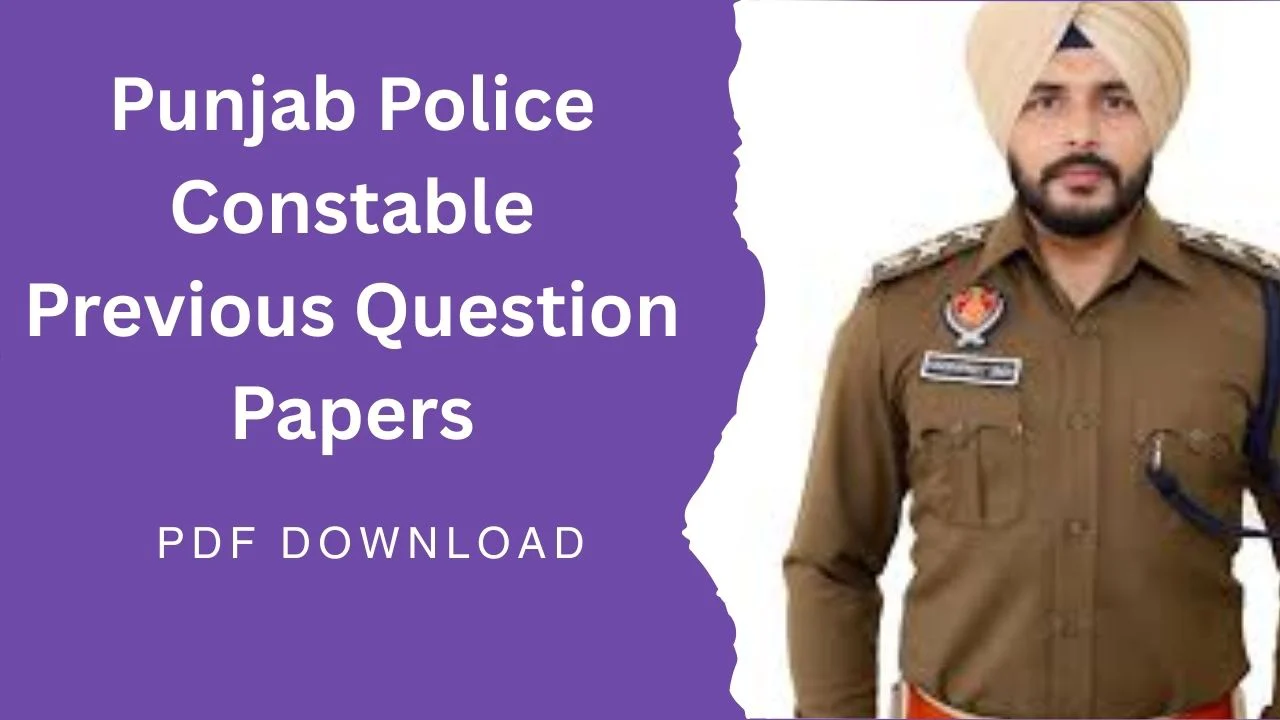
The Punjab Police Department has recently released the Punjab Police Constable Recruitment 2026 notification (Advt. No. 01/2026), announcing a massive drive to fill 3,298 vacancies across the District (2,522 posts) and Armed Police (776 posts) cadres. Online applications are open from March 10, 2026, and will officially close on March 30, 2026. With thousands of candidates expected to compete, the selection process—which includes a Computer-Based Test (CBT), Physical Measurement Test (PMT), Physical Screening Test (PST), and Document Verification—promises to be highly competitive. Solving Punjab Police Constable Previous Question Papers is the most effective way for applicants to master the CBT stage and move closer to their dream of serving in the state police.
Punjab Police Constable Recruitment 2026: Overview
| Organization | Punjab Police Department |
| Post Name | Constable (District & Armed Police Cadre) |
| Total Vacancies (2026) | 3,298 Posts |
| Application Dates | March 10, 2026 – March 30, 2026 |
| Selection Process | CBT, PMT/PST, Document Scrutiny |
| Exam Mode | Online (Computer-Based Test) |
| Job Location | Punjab |
| Basic Pay | Rs. 19,900/- per month (Level 2) |
| Official Website | punjabpolice.gov.in |
Punjab Police Constable Exam Pattern 2026
The first and most crucial stage of the Punjab Police Constable selection process is the Computer-Based Test (CBT). The CBT is divided into two distinct papers conducted in a single session. Paper I is the primary merit-determining test, comprising 100 objective-type questions across various subjects. Paper II is a mandatory qualifying test focusing entirely on Punjabi language proficiency. A massive advantage for candidates is that there is no negative marking for incorrect answers on either paper, which strongly encourages them to attempt all questions.
| Paper | Subject / Section | No. of Questions | Maximum Marks | Duration |
| Paper I (Merit-Based) | General Awareness | 35 | 35 | 2 Hours (120 Mins) |
| Quantitative Aptitude & Numerical Skills | 20 | 20 | ||
| Mental Ability & Logical Reasoning | 20 | 20 | ||
| English Language Skills | 10 | 10 | ||
| Punjabi Language Skills | 10 | 10 | ||
| Digital Literacy & Awareness | 5 | 5 | ||
| Paper I Total | 100 | 100 | ||
| Paper II (Qualifying) | Punjabi Language Proficiency | 50 | 50 | 1 Hour (60 Mins) |
| Grand Total | 150 | 150 | 3 Hours |
(Note: Candidates must score a minimum of 25 marks (50%) in Paper II to qualify. These marks, however, are not added to the final merit list.)
Previous Paper Analysis: Subject-wise Breakdown
Analyzing the previous question papers reveals key trends that can streamline your study plan:
1. General Awareness (35 Marks)
Historically, this is the most critical section. Previous papers show a heavy emphasis on state-specific knowledge.
Key Focus Areas: History, Geography, and Culture of Punjab. Key features of the Indian Constitution, local government institutions, and recent current affairs.
2. Quantitative Aptitude & Numerical Skills (20 Marks)
This section tests foundational mathematics up to the 10th-grade level. Past trends indicate the questions are straightforward but can be calculation-intensive.
Key Focus Areas: Simplification, Fractions & Decimals, Ratio & Proportion, Percentages, Profit & Loss, Simple Interest, and Time & Work.
3. Mental Ability & Logical Reasoning (20 Marks)
Reasoning questions in past exams have ranged from easy to moderate. Accuracy here is highly rewarding.
Key Focus Areas: Number and Letter Series, Pattern Completion, Sequencing, Direction and Distances, and Relationship problems.
4. Language Skills: English & Punjabi (10 Marks Each)
The language sections evaluate basic grammar rules and reading comprehension.
Key Focus Areas: Error spotting, fill in the blanks, vocabulary (synonyms/antonyms), reading comprehension, and translation from English to Punjabi (and vice-versa).
5. Digital Literacy & Awareness (5 Marks)
A quick and high-scoring section if you have basic computer literacy.
Key Focus Areas: Fundamentals of computers, MS Office (Word, PowerPoint), basic internet concepts, and email communication.