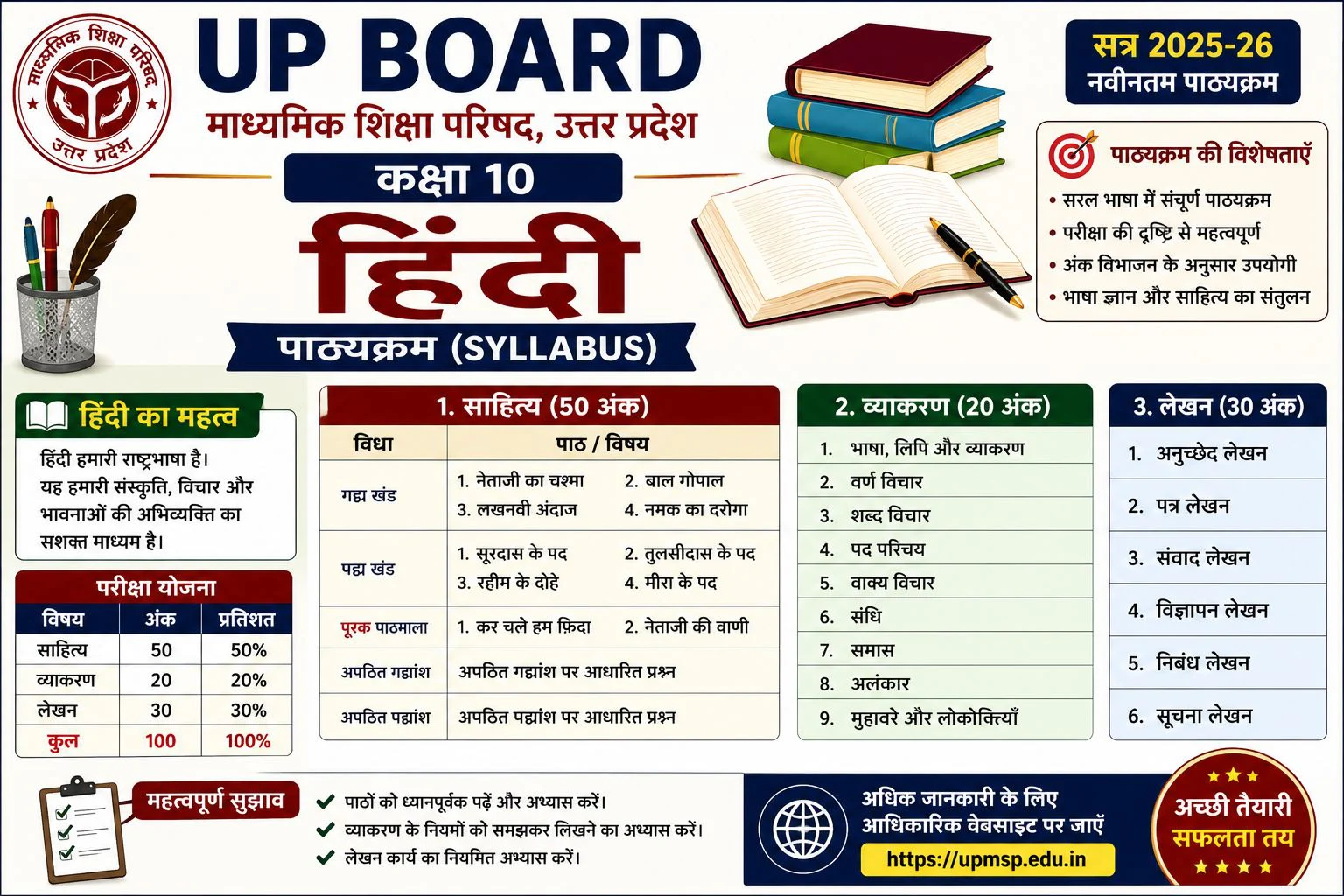
UP Board Class 10 Hindi Exam Pattern Section Details: The Uttar Pradesh Madhyamik Shiksha Parishad (UPMSP) has structuralized the UP Board Class 10 Hindi Syllabus for the academic session 2026–27. Designed to enrich students’ linguistic aptitude, the curriculum combines traditional text analysis, creative writing, history of literature, and core functional grammar. Below is the detailed breakdown of the complete framework, section-wise marks allotment, external and internal evaluation systems, and district-wise text maps.
Evaluation Blueprint & Exam Framework
The high school Hindi examination architecture spans a total evaluation matrix of 100 marks. This is broadly categorized into a written board paper and local school assessments:
Written (External) Examination: 70 Marks
Internal Assessment: 30 Marks
Subject Overview
| Parameter | Structural Details |
| Exam Mode | Offline (Pen and Paper) |
| Written Max Marks | 70 Marks |
| Internal Max Marks | 30 Marks |
| Question Paper Layout | 2 Independent Segments: Part-A (MCQs) & Part-B (Descriptive) |
Section-Wise Unit & Marks Distribution
The curriculum splits the theoretical marks dynamically across four foundational units:
| Unit Classification | Syllabus Inclusions & Functional Focus | Target Value |
| Unit 1 | History of Hindi Prose Literature & Core Prose Textual Segment | 16 Marks |
| Unit 2 | History of Hindi Poetry Literature, Core Verse Texts, & Khanda Kavya | 19 Marks |
| Unit 3 | Elements of Poetic Brilliance (Kavya Soundarya) & Sanskrit Chapter Section | 17 Marks |
| Unit 4 | Letter Writing (Patra Lekhan), Standard Applied Grammar, & Long Essay | 18 Marks |
| Total Weightage | External Syllabus Aggregate Matrix | 70 Marks |
Broad Question Paper Design (70 Marks)
The written paper comprises structural queries split perfectly into two operational domains:
Part-A: Multiple Choice Questions (20 Marks)
Students must mark accurate options for 20 objective-type standalone questions ($20 \times 1 = 20\text{ Marks}$) spread out as follows:
Development of Hindi Prose: Brief history focusing on Shukla Yug and Shuklotar Yug ($5 \times 1 = 5\text{ Marks}$).
Development of Hindi Poetry: Brief history focusing on Reetikal and Aadhunik Kaal ($5 \times 1 = 5\text{ Marks}$).
Elements of Poetic Aesthetics (Kavya Soundarya): Covers Definitions, Examples, and Identification ($3 \times 1 = 3\text{ Marks}$):
Rasa: Hasya and Karun Rasa.
Alankar (Arth封装lankar): Upma, Rupak, and Utpreksha.
Chhanda: Sortha and Rola.
Hindi Grammar (Shabda Rachna): Identification of rules ($3 \times 1 = 3\text{ Marks}$):
Prefixes (Upsarg): अ, अन्, अधि, अप, अनु, उप, सह, निर, अभि, परि, सु, etc.
Compound Words (Samas): Dvandva, Dvigu, Karmadharaya, and Bahuvrihi.
Vocabulary: Tadbhav, Tatsam, and Synonyms (Paryayvachi).
Sanskrit Grammar: Pronouns (Sarvanam – तद्, युष्मद्) ($1 \times 1 = 1\text{ Mark}$).
Sentence Structure & Mechanics: Sentence types, voice types (Vachya Prayog & transformations), and word introduction (Pada Parichay – variable and invariable words) ($3 \times 1 = 3\text{ Marks}$).
Part-B: Descriptive & Analytical Questions (50 Marks)
This section calls for long descriptions, annotations, translations, and biographical breakdowns:
Prose Text Comprehension: Questions based on reference context passages ($3 \times 2 = 6\text{ Marks}$).
Poetry Passage Breakdown: Textual comprehension queries based on stanzas ($3 \times 2 = 6\text{ Marks}$).
Sanskrit Prose Translation: Context reference context heading followed by translation to Hindi ($2 + 3 = 5\text{ Marks}$).
Sanskrit Verse Translation: Context description followed by Hindi verse rendering ($2 + 3 = 5\text{ Marks}$).
Khanda Kavya Evaluation: Analytical questions regarding plot, themes, or character sketches ($3 \times 1 = 3\text{ Marks}$).
Biographical Profiles (Life Sketches):
Prose Writers: Biography and significant literary creations ($3 + 2 = 5\text{ Marks}$).
Poets/Verse Writers: Biography and significant literary creations ($3 + 2 = 5\text{ Marks}$).
Sanskrit Stanza Recitation: Writing one verse memorized by heart (must not belong to the current test paper text) ($2 \times 1 = 2\text{ Marks}$).
Letter Writing (Patra Lekhan): Formal or informal writing applications ($4 \times 1 = 4\text{ Marks}$).
Sanskrit Short Answers: Answering any two textual questions in Sanskrit ($1 + 1 = 2\text{ Marks}$).
Analytical Essay (Nibandh): Long essay based on issues like science, society, religion, culture, economy, population explosion, health, education, environment, or traffic rules ($7 \times 1 = 7\text{ Marks}$).
Mandatory Text Content Layout
The board has frozen the following content list for text analysis:
A. Core Prose (Gadya) Sections
Ram Chandra Shukla: Mitrata
Jaishankar Prasad: Mamta
Rajendra Prasad: Bharatiya Sanskriti
Bhagwat Sharan Upadhyay: Ajanta
Padumlal Punnalal Bakshi: Kya Likhoon
Ramdhari Singh Dinkar: Eershya Tu Na Gayi Mere Man Se
Jay Prakash Bharti: Paani Mein Chanda Aur Chaand Par Aadmi
B. Core Poetry (Kavya) Stanzas
Surdas: Pada
Tulsidas: Dhanush Bhang, Van Path Par
Raskhan: Savaiye, Kavitt
Bihari Lal: Bhakti Neeti
Ramnaresh Tripathi: Swadesh Prem
Maithilisharan Gupt: Bharatmata Ka Mandir Yeh
Mahadevi Verma: Himalaya Se, Varsha Sundari Ke Prati
Sumitranandan Pant: Cheenti, Chandralok Mein Pratham Baar
Makhan Lal Chaturvedi: Pushp Ki Abhilasha, Jawani
Subhadra Kumari Chauhan: Jhansi Ki Rani Ki Samadhi Par
Ashok Bajpai: Bhasha Ekmatra Anant Hai, Yuva Jungle
Shyam Narayan Pandey: Haldighati
Kedar Nath Singh: Nadi
C. Sanskrit Chapters (Sanskrit Khand)
Varanasi, Deshbhaktah Chandrashekharah, Bharatiyah Sanskritih, Veerah Veeren Poojyate, Aaruni-Shvetaketu Samvadah, Jeevan-Sootrani, Prabuddho Grameenah, Ken Kim Vardhate, and Anyokti-Vilasah.
District-Wise Distribution Matrix for Khanda Kavya
Students must prepare the Khanda Kavya book specifically assigned to their respective district of study:
| S.No. | Assigned Book Title | Covered Districts under Selection |
| 1 | Muktidoot | Agra, Basti, Ghazipur, Fatehpur, Barabanki, Unnao, Firozabad, Siddharthnagar, Sant Kabir Nagar. |
| 2 | Jyoti Jawahar | Kanpur, Pratapgarh, Mirzapur, Rampur, Gonda, Kanpur Dehat, Balrampur, Sonbhadra. |
| 3 | Agrapuja | Prayagraj, Azamgarh, Mathura, Mau, Kaushambi. |
| 4 | Mewar Mukut | Bulandshahr, Deoria, Bareilly, Sultanpur, Sitapur, Bahraich, Amethi, Kushinagar, Shravasti. |
| 5 | Jai Subhash | Lucknow, Saharanpur, Faizabad, Banda, Jhansi, Hardoi, Ambedkar Nagar, Chitrakoot, Lalitpur. |
| 6 | Matribhoomi Ke Liye | Gorakhpur, Moradabad, Shahjahanpur, Lakhimpur Kheri, Mainpuri, Muzaffarnagar, Maharajganj, Shamli, Amroha, Sambhal. |
| 7 | Karna | Mahoba, Aligarh, Jaunpur, Ballia, Hamirpur, Etah, Hathras, Kasganj. |
| 8 | Karmaveer Bharat | Meerut, Farrukhabad, Pilibhit, Raebareli, Ghaziabad, Gautam Buddha Nagar, Hapur, Baghpat, Kannauj. |
| 9 | Tumul | Varanasi, Etawah, Bijnor, Jalaun, Budaun, Bhadohi, Chandauli, Auraiya. |
⚠️ Note: For newly created or unlisted districts, the allocated text allocations follow previous historical parameters mapped to their parental administrative districts.
Internal School Evaluation Setup (30 Marks)
Internal marks are continuously monitored at the school level throughout the 2026–27 academic year across three evaluation points:
First Internal Assessment (10 Marks): Conducted in August; focused entirely on oral expression and speech skills (Maukhi Abhivyakti).
Second Internal Assessment (10 Marks): Conducted in December; focuses on creative, compositional, and narrative writing abilities (Rachnatmak Lekhan).
Third Internal Assessment (10 Marks): Calculated based on the average performance across Four Unit Tests.
Unit Test Academic Timeline
Unit Test 1 (MCQ Format): Second week of July (Scaled from 20 total points: 10 marks Summer Vacation Homework + 10 marks Written Test).
Unit Test 2 (Descriptive Format): Last week of August (Evaluated out of 20 marks).
Unit Test 3 (MCQ Format): Last week of November (Evaluated out of 20 marks).
Unit Test 4 (Descriptive Format): Last week of December (Evaluated out of 20 marks).
Note: The collective scores of all four terminal unit tests are mathematically scaled down to a maximum range of 10 marks for the final score compilation.