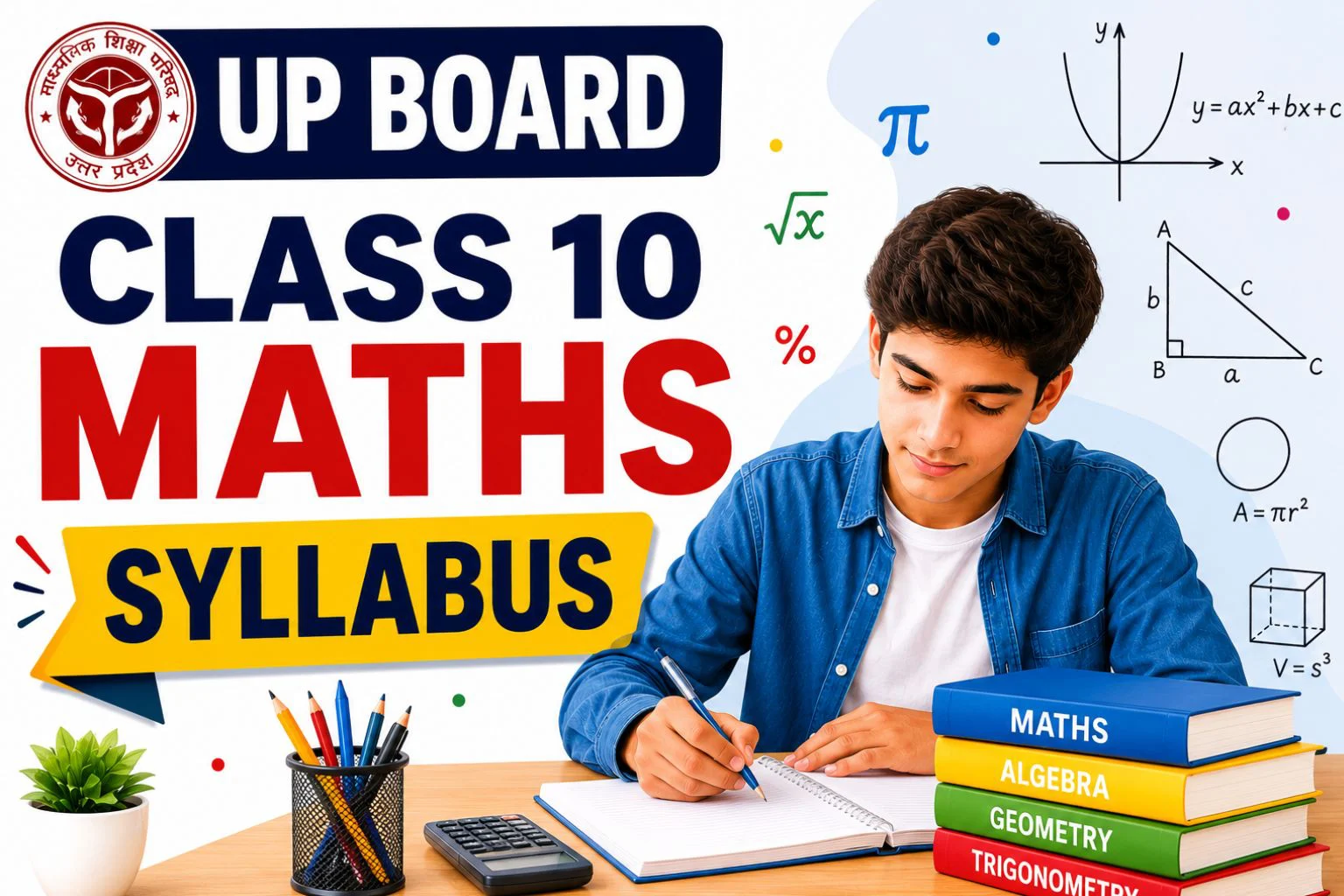
UP Board Class 10 Mathematics Syllabus 2026-27 Complete Exam Pattern, Weightage, and Project Details: The Uttar Pradesh Madhyamik Shiksha Parishad (UPMSP) has officialized the structural core of the UP Board Class 10 Mathematics Syllabus for the academic session 2026–27. Designed to develop computational skills, analytical thinking, and geometric concepts, the curriculum outlines the theoretical weightage, core textbook units, and a continuous internal evaluation layout.
UP Board Class 10 Maths Exam Pattern and Passing Criteria 2026-27
The high school Mathematics evaluation matrix spans a total configuration of 100 marks. This structure comprises an external written board test alongside continuous school-level practical/project assessments:
Written (External) Examination: 70 Marks
Internal Assessment & Project Work: 30 Marks
Minimum Qualifying Pass Marks: Students must secure a minimum of 23 marks in the written paper and 10 marks in the internal school evaluation, aggregating to a mandatory passing threshold of 33 marks total.
UP Board 10th Maths Examination Overview
| Parameter | Structural Details |
| Exam Mode | Offline (Pen and Paper) |
| Written Max Marks | 70 Marks |
| Internal Assessment Max Marks | 30 Marks |
| Minimum Passing Target | 23 (Written) + 10 (Internal) = 33 Marks |
UP Board Class 10 Mathematics Unit-Wise Marks Distribution
The theoretical examination paper aggregates to 70 marks, distributed systematically across seven structural core units:
| Unit Number | Unit Name (Hindi / English) | Target Weightage |
| I | संख्या पद्धति (Number System) | 05 Marks |
| II | बीजगणित (Algebra) | 18 Marks |
| III | निर्देशांक ज्यामिति (Coordinate Geometry) | 05 Marks |
| IV | ज्यामिति (Geometry) | 10 Marks |
| V | त्रिकोणमिति (Trigonometry) | 12 Marks |
| VI | मेन्सुरेशन (Mensuration) | 10 Marks |
| VII | सांख्यिकी तथा प्रायिकता (Statistics & Probability) | 10 Marks |
| Total | External Examination Matrix Aggregate | 70 Marks |
Detailed UP Board Class 10 Maths Syllabus 2026-27 (Topic-Wise)
Unit I: Number System (संख्या पद्धति) — 05 Marks
Real Numbers (वास्तविक संख्याएँ): Fundamental Theorem of Arithmetic with examples. Re-visiting and verifying irrational numbers, including proofs for the irrationality of $\sqrt{2}$, $\sqrt{3}$, and $\sqrt{5}$.
Unit II: Algebra (बीजगणित) — 18 Marks
Polynomials (बहुपद): Zeros of a polynomial and their geometric meaning. Relationship between the zeros and coefficients of quadratic polynomials.
Pair of Linear Equations in Two Variables (दो चर वाले रैखिक समीकरण युग्म): Solving systems of linear equations using graphical methods. Algebraic methods of solving linear pairs:
Substitution Method (प्रतिस्थापन विधि)
Elimination Method (विलोपन विधि)
Quadratic Equations (द्विघात समीकरण): Standard form of a quadratic equation
$$ax^2 + bx + c = 0 \quad (a \ne 0)$$Finding real roots using the quadratic formula and factorization methods. Relationship between the discriminant and the nature of roots. Real-world applications and word problems based on quadratic equations.
Arithmetic Progressions (समान्तर श्रेणियाँ): Derivation of the $n\text{-th}$ term ($a_n$) and calculating the sum of the first $n$ terms ($S_n$) of an AP. Application of AP principles to solve practical daily-life word problems.
Unit III: Coordinate Geometry (निर्देशांक ज्यामिति) — 05 Marks
Lines in Two Dimensions (रेखा – द्विविमीय): Basic concepts of coordinate geometry, plotting graphs of linear equations, Distance Formula, and Section Formula (internal division only).
Unit IV: Geometry (ज्यामिति) — 10 Marks
Triangles (त्रिभुज): Definitions, examples, and counter-examples of similar triangles. Core geometric theorems to be studied and verified:
A line drawn parallel to one side of a triangle divides the other two sides in the same ratio.
A line that divides any two sides of a triangle in the same ratio is parallel to the third side.
If in two triangles, a pair of corresponding sides is proportional and their included angles are equal, the triangles are similar (SAS similarity).
If in two triangles, corresponding angles are equal and their corresponding sides are proportional, the triangles are similar (AAA similarity).
If one angle of a triangle is equal to one angle of another triangle and the sides including these angles are proportional, the triangles are similar.
Circles (वृत्त): Tangent to a circle and point of contact. Key geometric theorems include:
The tangent at any point of a circle is perpendicular to the radius through the point of contact.
The lengths of tangents drawn from an external point to a circle are equal.
Analysing the total number of tangents drawn from a single point to a circle.
Unit V: Trigonometry (त्रिकोणमिति) — 12 Marks
Introduction to Trigonometry (त्रिकोणमिति का परिचय): Trigonometric ratios of acute angles in a right-angled triangle. Ratios of specific benchmark angles: $0^\circ$, $30^\circ$, $45^\circ$, $60^\circ$, and $90^\circ$, along with their values and inter-relationships.
Trigonometric Identities (त्रिकोणमितीय सर्वसामिकाएँ): Proofs, establishment, and application of standard trigonometric identities, including:
$$\sin^2\theta + \cos^2\theta = 1$$$$1 + \tan^2\theta = \sec^2\theta$$$$1 + \cot^2\theta = \csc^2\theta \quad (\text{where } 0^\circ \le \theta < 90^\circ)$$Heights and Distances (ऊँचाई और दूरी): Simple application problems mapping angles of elevation (उन्नयन कोण) and angles of depression (अवनमन कोण). Problems are restricted to a maximum of two right-angled triangles, utilizing only $30^\circ$, $45^\circ$, and $60^\circ$ angles.
Unit VI: Mensuration (मेन्सुरेशन) — 10 Marks
Areas Related to Circles (वृत्तों से सम्बन्धित क्षेत्रफल): Computing the surface area of sectors (त्रिज्यखंड) and segments (वृत्तखण्ड) of a circle.
Surface Areas and Volumes (पृष्ठीय क्षेत्रफल और आयतन): Calculating surface areas and volumes of combinations of any two standard solids: cubes, cuboids, spheres, hemispheres, and right circular cylinders/cones. Mixed combination problems are strictly limited to the interface junction of two distinct solid types.
Unit VII: Statistics and Probability (सांख्यिकी तथा प्रायिकता) — 10 Marks
Statistics (सांख्यिकी): Computation of the Mean, Median, and Mode for grouped numerical data distributions.
Probability (प्रायिकता): Classical, theoretical definition of probability with simple practical problems structured around single-stage events.
UP Board 10th Maths Internal Assessment and Marking Scheme
School-level evaluation tracks mathematical alignment continuously across the session through distinct internal assessment blocks:
First Internal Assessment (10 Marks): Scheduled for August; comprising a combined Project block and an Oral Quiz session ($5 + 5\text{ Marks}$). The core project is explicitly structured around the institutional reference book titled “Traditional Mathematical Knowledge of India”.
Second Internal Assessment (10 Marks): Scheduled for December; based on an evaluated Project presentation and maintaining structural exercise workbook records ($5 + 5\text{ Marks}$).
Third Internal Assessment (10 Marks): Formulated from the aggregate performance tracking of Four Unit Tests.
UP Board Class 10 Unit Test Academic Schedule
Unit Test 1 (MCQ Based): Second week of July (Scaled out of 20 total points: 10 marks assigned for Summer Vacation Homework + 10 marks Written Quiz Test).
Unit Test 2 (Descriptive Based): Last week of August (Evaluated out of 20 marks).
Unit Test 3 (MCQ Based): Last week of November (Evaluated out of 20 marks).
Unit Test 4 (Descriptive Based): Last week of December (Evaluated out of 20 marks).
Evaluation Note: The total consolidated marks obtained across all four unit tests must be mathematically normalized down to a scale out of 10 marks for final board entry compiling.
UP Board Class 10 Maths Project Work and Practical Topics
Students are required to select and complete one project out of topics 1 to 11, and one mandatory project explicitly from selection point 12. Teachers can also issue alternative custom projects mapping directly to the syllabus lines.
Verification of Pythagoras Theorem using cardboard sheets or chart cut-outs of triangles and squares.
Analyzing the structural utilities of statistical tools within population and demographic research studies.
Investigating the structural role and aesthetic application of various geometric shapes within historical architecture and construction design.
Designing charts mapping out the algebraic sign rules of trigonometric ratios across different quadrants, alongside pictorial mappings of complementary and supplementary angle configurations.
A comprehensive study on the biographical profile, historical timeline, and core conceptual contributions of any one prominent Indian mathematician from the post-medieval period (e.g., Srinivasa Ramanujan, Narayana Pandit).
Constructing two separate geometric cylinders out of standard paper sheets measuring $24\text{ cm} \times 42\text{ cm}$ (one rolled lengthwise, the other widthwise) to calculate and contrast their comparative curved surface areas and absolute volumetric capacities.
Conducting a structured analytical survey on various forms of direct and indirect taxes deployed by the government.
Creating a working geometric model or interactive representation illustrating that the angle subtended by an arc at the center of a circle is double the angle subtended by it at any point on the remaining part of the circumference.
Designing and operating a homemade Sextant device to practically compute heights and distance variations.
Exploring the utility, balance, and operational application of foundational mathematical principles within the domain of fine arts and classical paintings.
Documenting a comparative breakdown mapping the operational processes, verification checkpoints, and payment terms involved in securing a bank loan for purchasing a house or vehicle.
Mandatory Segment: Select any one extensive project topic using the sections of the prescribed book “Traditional Mathematical Knowledge of India”:
Section A (खण्ड-क): The Glorious Tradition of Mathematics in India (भारत में गणित की उज्ज्वल परम्परा).
Section B (खण्ड-ख): Traditional Methodology and Algorithms of Calculation (गणना की परम्परागत विधियां).
Section C (खण्ड-ग): Prominent Mathematicians of India and their Core Treatises (भारत के प्रमुख गणिताचार्य).
UP Board Class 10 Maths Syllabus 2026-27 Download PDF