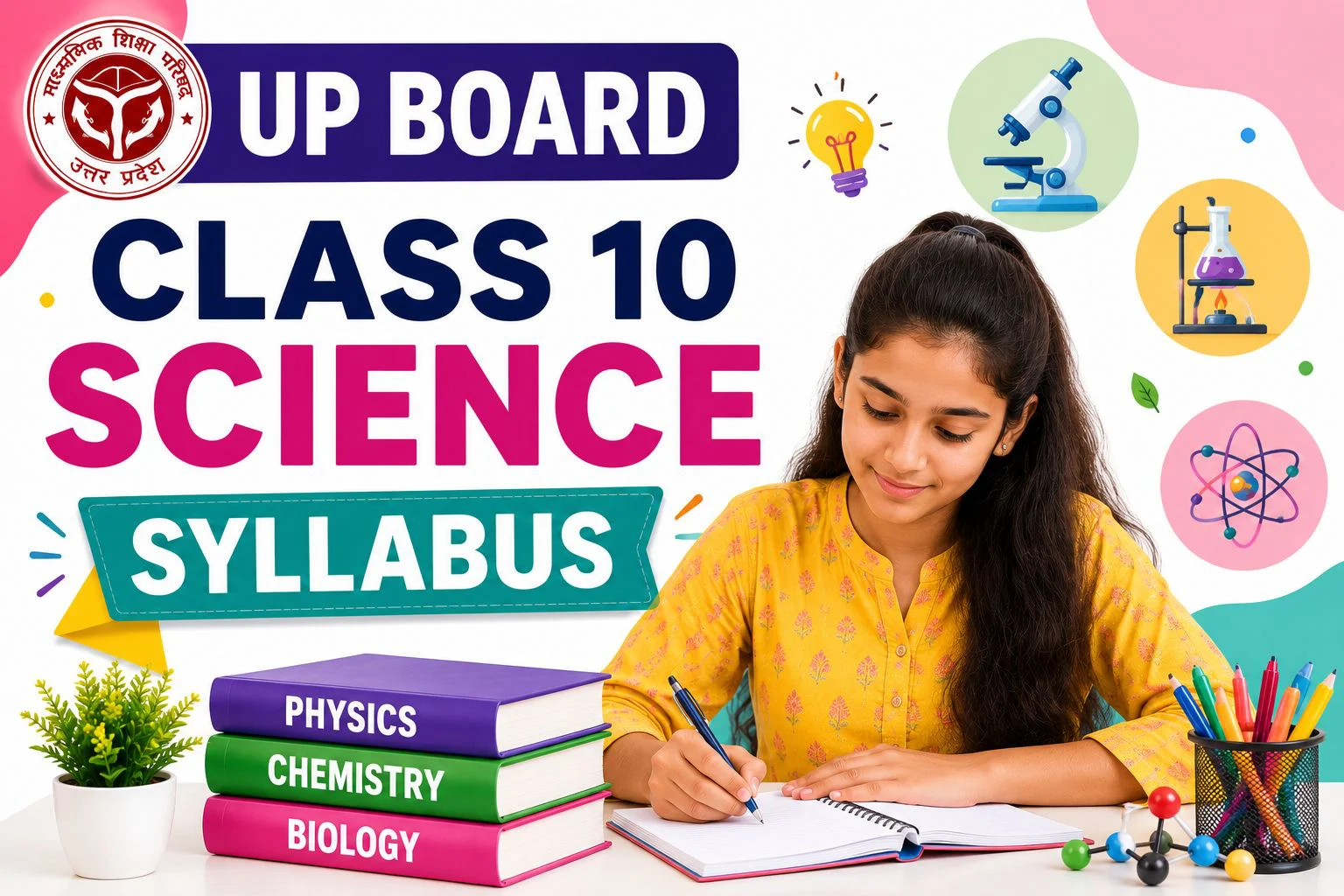
The Uttar Pradesh Madhyamik Shiksha Parishad (UPMSP) has released the structured curriculum and blueprint for the UP Board Class 10 Science Syllabus for the academic session 2026–27. The syllabus seamlessly integrates theoretical frameworks, experimental procedures, project tasks, and continuous evaluation models to ensure deep scientific literacy across Chemistry, Biology, and Physics.
UP Board Class 10 Science Exam Pattern and Passing Criteria 2026-27
The High School Science assessment model comprises a 100-mark evaluation grid, split systematically into a written board examination and a center-level practical/project framework:
Written (External) Board Paper: 70 Marks
Practical & Internal School Work: 30 Marks
Minimum Qualifying Pass Marks: Students must secure a minimum of 23 marks in the theoretical board exam and 10 marks in the school-level practical assessment, leading to a mandatory passing threshold of 33 marks total.
UP Board 10th Science Examination Overview
| Evaluation Parameter | Marks Allotment | Passing Target |
| Written Board Examination (Likhit Pariksha) | 70 Marks | 23 Marks |
| Practical Examination (Prayogatmak Pariksha) | 30 Marks | 10 Marks |
| Total Marks Combined | 100 Marks | 33 Marks |
UP Board Class 10 Science Unit-Wise Marks Distribution
The theoretical examination blueprint distributes 70 marks systematically across five major core domains:
| Unit Serial Number | Core Academic Units (Hindi / English) | Marks Weightage |
| 1 | रासायनिक पदार्थ- प्रकृति एवं व्यवहार (Chemical Substances – Nature & Behaviour) | 20 Marks |
| 2 | जैव जगत (World of Living) | 20 Marks |
| 3 | प्राकृतिक घटनायें (Natural Phenomena) | 12 Marks |
| 4 | विद्युत का प्रभाव (Effects of Current) | 13 Marks |
| 5 | प्राकृतिक संसाधन (Natural Resources) | 05 Marks |
| Total | Theory Examination Matrix Aggregate | 70 Marks |
Detailed UP Board Class 10 Science Syllabus 2026-27 (Topic-Wise)
Unit 1: Chemical Substances – Nature & Behaviour (20 Marks)
Chemical Reactions and Equations: Balanced chemical equations and their implications. Types of chemical processes: combination, decomposition, single displacement, double displacement, precipitation, neutralization, oxidation, and reduction reactions.
Acits, Bases, and Salts: Definition of acids, bases, and salts based on H^+ and OH^- ions. General properties, real-world examples, and foundational applications. Concept of pH scale (excluding mathematical logarithmic derivations) and importance of pH in daily life. Methods of preparation and utilities of Sodium Hydroxide, Bleaching Powder, Baking Soda, Washing Soda, and Plaster of Paris.
Metals and Non-Metals: Physical and chemical properties of metals and non-metals. Formation, features, and properties of ionic compounds. Reactivity series, basic metallurgical principles, and prevention/remediation of corrosion.
Carbon and its Compounds: Covalent bonding in carbon systems and its versatile nature. Homologous series and IUPAC nomenclature rules for functional groups containing halogens, alcohols, ketones, aldehydes, alkanes, and alkynes. Structural distinctions between saturated and unsaturated hydrocarbons. Chemical properties of carbon compounds: combustion, oxidation, addition, and substitution reactions. Physical properties and industrial utilities of Ethanol and Ethanoic acid (basic properties and uses only), along with the chemistry of soaps and detergents.
Unit 2: World of Living (20 Marks)
Life Processes: Basic conceptual frameworks of nutrition, respiration, molecular transport, and metabolic excretion systems in plants and animals.
Control and Coordination: Directional and tropic movements in plant systems. Introduction to plant hormones. Nervous system architecture in animal bodies, voluntary and involuntary muscular movements, reflex actions, chemical coordination, and animal hormones.
How do Organisms Reproduce?: Sexual and asexual reproduction channels in plants and animals. Reproductive health guidelines: core requirements, family planning methodologies, safe sexual practices, awareness regarding HIV/AIDS, and maternal-child health.
Heredity: Core inheritance mechanisms, Gregor Mendel’s key contributions, laws governing the inheritance of characters, and a brief introductory overview of sex determination.
Unit 3: Natural Phenomena (12 Marks)
Light – Reflection and Refraction: Reflection of light across curved surfaces, image configurations formed by spherical mirrors, center of curvature, principal axis, principal focus, focal length, mirror formula (derivation excluded), and magnification. Laws of refraction, refractive index, refraction via spherical lenses, rules for image layouts via lenses, lens formula (derivation excluded), magnification, and optical power of a lens.
Human Eye and the Colorful World: Functions of the crystalline lens inside the human eye, optical defects (Myopia, Hypermetropia) and their structural remedies, and applications of spherical mirrors and lenses. Refraction of light passing through a glass prism, dispersion of light, scattering of light, and natural real-world phenomenon applications.
Unit 4: Effects of Current (13 Marks)
Electricity: Electric current, potential difference, Ohm’s law, electrical resistance, resistivity, and variables affecting the resistance of a conductor. Series and parallel combinations of resistors along with daily life applications. Heating effects of electric current, electric power, and the algebraic inter-relationships between P, V, I, and R.
Magnetic Effects of Electric Current: Magnetic fields, magnetic field lines, and field layout around a current-carrying straight conductor, solenoid coil, and circular loop. Force exerted on a current-carrying conductor placed inside a magnetic field, Fleming’s Left-Hand Rule, Right-Hand Thumb Rule, and domestic electrical circuit mapping.
Unit 5: Natural Resources (05 Marks)
Our Environment: Ecological ecosystems, structural environmental concerns, depletion patterns of the Ozone layer, waste production management and its reduction strategies, and biodegradable vs. non-biodegradable waste materials.
UP Board 10th Science Practical Marks Layout (30 Marks)
The experimental marking system aggregates to 30 marks, evaluated equally by external and internal examiners (15 + 15\text{ Marks}):
External Examiner Assessment Layout (15 Marks)
The visiting external examiner evaluates three practical experiments (one selected from Physics, Chemistry, and Biology individually) alongside a viva-voce:
Physics Practical Performance: 04 Marks
Chemistry Practical Performance: 04 Marks
Biology Practical Performance: 04 Marks
Viva-Voce (Maukhiki): 03 Marks
Internal Examiner Assessment Layout (15 Marks)
The center-level evaluation charts daily academic portfolios across two core indices:
Project Work Portfolios: 09 Marks (Students must submit three distinct projects, one each from Physics, Chemistry, and Biology).
Sessional Class Records: 06 Marks.
UP Board Class 10 Science Practical Activities List
Students are required to perform and log experimental observations spanning these practical setups:
Determining the precise pH values using pH paper or Universal Indicator across these samples:
Dilute HCl
Dilute NaOH solution
Dilute Ethanoic acid solution
Fresh Lemon juice
Distilled Water
Dilute Sodium Bicarbonate solution
Studying properties of acids and bases (HCl & NaOH) by evaluating their distinct chemical reactions with:
Litmus solutions (Red/Blue)
Zinc metal granules
Solid Sodium Carbonate
Executing, observing, and categorizing chemical reactions into combination, decomposition, displacement, or double displacement segments:
Action of water on quicklime
Thermal decomposition of Ferrous Sulfate crystals
Iron nails placed inside a Copper Sulfate solution
Reaction between Sodium Sulfate and Barium Chloride solutions
Observing the reactivity trends of Zn, Fe, Cu, and Al metals against their respective salt solutions to organize them in a descending order of chemical reactivity.
Investigating the structural dependence of potential difference (V) on the current (I) flowing through a resistor to compute its absolute resistance value and draw the corresponding V-I graph.
Determining the equivalent resistance configurations of individual resistors arranged in series and parallel circuits.
Preparing temporary mounts and slides of leaf peels to observe stomatal structures under a microscope.
Demonstrating via experimental setups that Carbon Dioxide (CO_2) gas is naturally released during aerobic respiration.
Investigating the structural chemical properties of Acetic Acid (Ethanoic Acid) regarding its odor, solubility parameters in water, reaction actions on litmus papers, and chemical reaction with Sodium Hydrogen Carbonate.
Comparing the cleansing action and foam-producing capacities of standard soap solutions inside soft water vs. hard water samples.
Finding the focal length parameters of a concave mirror and a convex lens via distant object image projection.
Tracing the geometric paths of light rays traversing a rectangular glass slab for various angles of incidence to calculate the angles of incidence, refraction, and emergence.
Studying steps of binary fission in Amoeba and budding structures in Yeast utilizing prepared permanent slides.
Tracing the path of light rays passing through a standard glass prism.
Dissecting and analyzing the structural regions of a dicotyledonous seed embryo (e.g., peas, gram, rajma, or beans).
Mapping out and tracing the magnetic field lines generated around a standard bar magnet.
Approved Science Project Guidelines and Topics
Students must prepare three total projects (one each explicitly from Physics, Chemistry, and Biology areas) to compile their files. Instructors can also allot alternative topics aligning with the curriculum.
Natural Indicator pH Mapping: Using pH paper or universal indicator to analyze the pH levels and color variances of natural extracts (Lemon juice, Beetroot extract, Cabbage juice, boiled Pea water, and Rose petal extract).
Chemical Garden Design: Constructing an interactive chemical garden inside a glass jar using water glass solution combined with crystals of Copper Sulfate, Cobalt Sulfate, or Manganese Sulfate.
Thermochemistry Evaluation: Designing an experimental model to measure and evaluate the relative heat energy changes released during various acid-base neutralization reactions.
Madame Curie Profile Study: Compiling a biographical profile detailing Marie Curie’s life journey, academic timeline, radioisotope discoveries, and Nobel Prize accolades.
Electric Bell Model: Developing a operational layout model of a traditional Electric Bell to study its underlying electromagnetic induction principles.
Kaleidoscope Assembly: Assembling an operational model of a Kaleidoscope to evaluate reflection principles.
Indian Scientists Compendium: Documenting a detailed overview highlighting the historical timeline and structural contributions of prominent Indian scientists in modern science development.
Electrical Quiz Board: Building a fully functional electrical quiz board model supported by clear circuit diagram references.
Science in Entertainment: Conducting an illustrative, analytical study profiling the operational role of scientific principles within the entertainment sector.
Optical Mappings: Systematically recording, verifying, and charting the image behavior variations (nature, placement position, and relative size changes) produced by mirrors and lenses across variable object positions.
Floral Dissection Study: Analyzing the structural anatomy (sepals, petals, androecium, gynoecium) of a bisexual flower like Hibiscus or Mustard to trace its pollination mechanism.
Human Heart Anatomy: Building a descriptive structure model illustrating the chambers, valves, and circulatory pathways of the human heart.
Seed Germination Tracing: Tracing seed anatomy and absolute germination stages utilizing pre-soaked maize and bean seeds.
Herbarium Portfolio: Collecting, pressing, and processing various plant leaf specimens to design a systematic Herbarium portfolio book.
Hydroponics Project: Cultivating plant samples without soil media to record comparative observation matrices inside a final hydroponic project report.
Fuel Emission Analysis: Conducting an environmental analysis tracking vehicular air pollution caused by Petrol and Diesel engines, paired with investigation steps tracking the benefits of switching over to Compressed Natural Gas (CNG).
Plastic Pollution Footprint: Investigating the daily utility footprint of plastics and polythene compounds relative to their long-term degradation damage inside local ecosystems.
Acoustic Noise Pollution Survey: Conducting a localized, visual noise tracking survey charting the primary drivers and physiological health hazards of escalating decibel levels across urban centers.
UP Board Class 10 Science Unit Test Academic Schedule
For remedial teaching and academic support, the board outlines four terminal unit tests taken at the institutional level.
Unit Test 1 (MCQ Format): Second week of July (Aggregates to 20 marks: 10 marks Summer Vacation Homework + 10 marks Written Quiz Test).
Unit Test 2 (Descriptive Format): Last week of August (Evaluated out of 20 marks).
Unit Test 3 (MCQ Format): Last week of November (Evaluated out of 20 marks).
Unit Test 4 (Descriptive Format): Last week of December (Evaluated out of 20 marks).
Note: These terminal unit tests are managed strictly for internal diagnostic tracking and remedial teaching feedback; their final numerical scores are not added into the final board examination results.
UP Board Class 10 Science Syllabus 2026-27