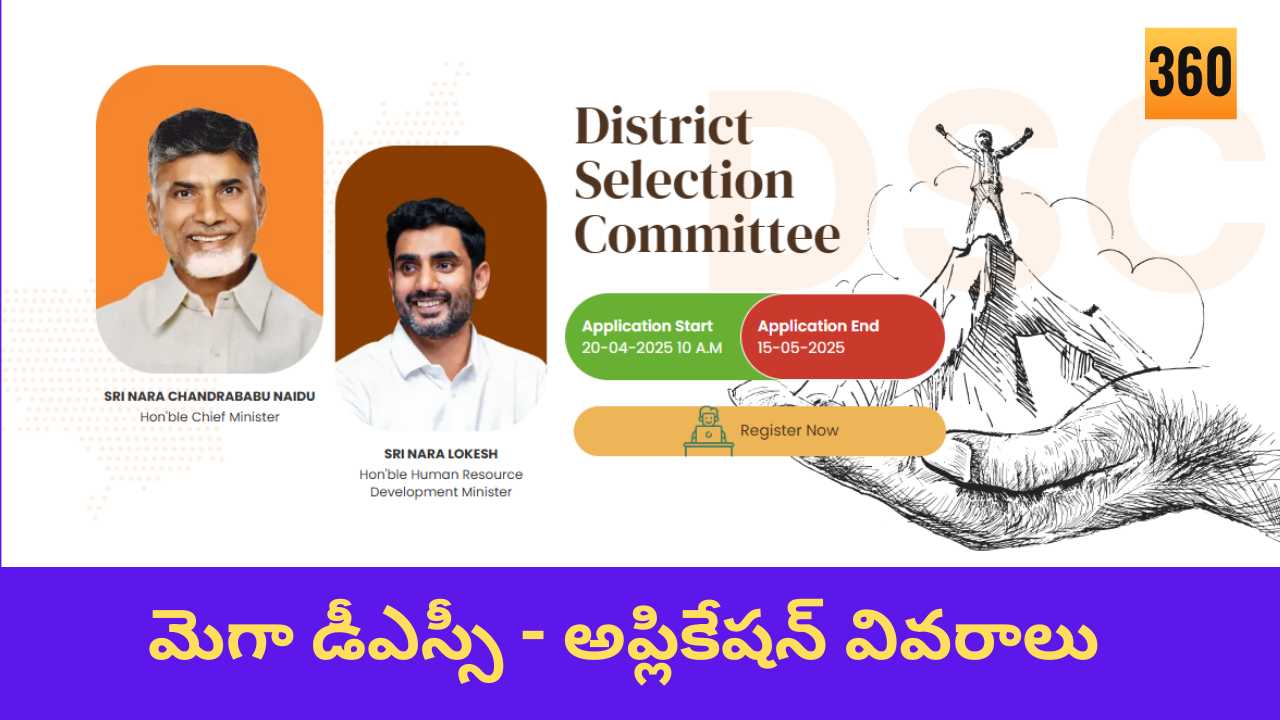
AP TET Cum TRT Urdu Teacher Syllabus & Previous Papers PDF: Candidates who want to apply for AP TET Urdu Teacher recruitment can apply online on the official website ap.gov.in. Candidates who applied for the AP TET Recruitment 2026 for Urdu Teacher Posts should start preparing for the Written Examination. Candidates searching for the TET Urdu Teacher Syllabus, here is the right place. Here on this Page, Schools360.Updated the complete Information about the Urdu Teacher Notification, like recruitment, Syllabus, exam pattern, topic-wise syllabus, Previous papers, etc.
Click Here For AP Urdu Teacher Recruitment 2026
AP TET Urdu Teacher Exam Pattern 2026 PDF
AP TET Cum TRT Urdu Teacher Complete Syllabus is Updated Here For the Candidates who are preparing for the Examination. In this page, Exam pattern of TET Urdu teacher Notification ID is available. From this, you can get the Syllabus, Marks Distribution, Weightage, etc.
AP TET Urdu Teacher Syllabus 2026 PDF
in this portal Tha Complete syllabus of AP TET Urdu Teachers is Updated. So candidates are requested to Download the Syllabus PDF For Free. There is no Need to pay anything For this.
TEACHER ELIGIBILITY TEST 2026
SYLLABUS PAPER I
(Content of School Subjects is as per old syllabus) I CHILD DEVELOPMENT AND PEDAGOGY (Marks: 30)
DEVELOPMENT OF CHILD
- Development, Growth & Maturation – Concept & Nature
- Principles of Development
- Factors influencing Development – Biological, Psychological, Sociological
- Dimensions of Development and their interrelationships – Physical & Motor, Cognitive, Emotional, Social, Moral, Language relating to Infancy, early Childhood, late Child
- Understanding Development – Piaget, Kohlberg, Chomsky, Carl Rogers
- Individual differences – Intra & Inter Individual differences in the areas of Attitudes, Aptitude, Interest, Habits, Intelligence and their Assessment
- Development of Personality – Concept, Factors effecting development of Personality
- Adjustment, Behavioral problems, Mental Health
- Methods and Approaches of Child Development – Observation, Interview, Case study, Experimental, Cross sectional and Longitudinal
- Developmental tasks and Hazards
UNDERSTANDING LEARNING
- Concept, Nature of Learning – Input – Process – Outcome
- Factors of Learning – Personal and Environmental
- Approaches to Learning and their applicability – Behaviorism (Skinner, Pavlov, Thorndike), Constructivism (Piaget, Vygotsky), Gestalt (Kohler, Koffka) and Observational (Bandura)
- Dimensions of Learning – Cognitive, Affective and Performance
- Motivation and Sustenance –its role in
- Memory & Forgetting
- Transfer of Learning
PEDAGOGICAL CONCERNS
- Teaching and its relationship with learning and learner
- Learners in Contexts: Situating learner in the socio-political and cultural context
- Children from diverse contexts – Children With Special Needs (CWSN), Inclusive Education
- Understanding of Pedagogic methods – Enquiry based learning, Project based learning, Survey, Observation and Activity based learning
- Individual and Group learning: Issues and concerns with respect to organizing learning in class room like Study habits, Self learning and Learning to learn skills
- Organizing learning in heterogeneous class room groups – Socio-economic background, Abilities and Interest
- Paradigms of organizing Learning – Teacher centric, Subject centric and Learner centric
- Teaching as Planned activity – Elements of Planning
- Phases of Teaching – Pre active, Interactive and Post active
- General and Subject related skills, competencies required in teaching and attributes of good facilitator
- Learning resources – Self, Home, School, Community, Technology
- Class room Management: Role of student, teacher, Leadership style of teacher, Creation of non-threatening learning environment, Managing behavior problems, Guidance & Counseling, Punishment and its legal implications, Rights of a child, Time
- Distinction between Assessment for Learning & Assessment of Learning, School based Assessment, Continuous & Comprehensive Evaluation : Perspective & Practice
- Understanding teaching & learning in the context of NCF, 2005 & Right To Education Act, 2009.
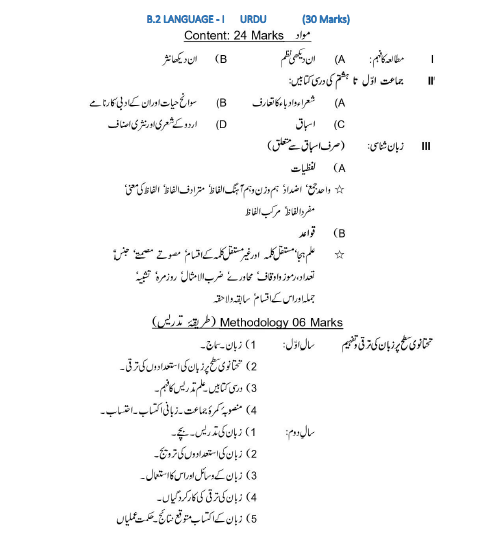
DSC School Assistant Urdu Syllabus PDF Download
II Language – I URDU (Marks 30)
III. LANGUAGE – II (ENGLISH) (Marks: 30) CONTENT (Marks: 24)
- Parts of Speech Tenses 3.Types of Sentences 4.Prepositions & Articles
- Degrees of Comparison 6. Direct and Indirect Speech 7. Questions and question tags,
- Active & Passive voice 9. Use of Phrases 10. Comprehension 11.Composition 12. Vocabulary.
PEDAGOGY (Marks: 06)
- Aspects of English:- (a) English language – History, nature, importance, principles of English as second language (b) Problems of teaching / learning English
- Objectives of teaching
- Phonetics
- Development of Language skills:- a Listening, Speaking, Reading & Writing (LSRW).
- b) Communicative skills.
- Approaches, Methods, Techniques of teaching
- Introduction, Definition and Types of approaches methods and techniques of teaching English (b)Remedial
- Teaching of structures and vocabulary
- Teaching learning materials in English
- Lesson Planning
- Curriculum & Textbooks
- Evaluation in English language
MATHEMATICS (Marks: 30) CONTENT (Marks: 24)
- Number system: Whole numbers, place value, comparison, fundamental mathematical operations ; Addition, Subtraction, Multiplication and Division, Indian Currency, Prime and Composite numbers, Prime factors, Lowest Common Multiple (LCM) and Greatest Common Multiple (GCM).
- Fractions: Concept of fractions, proper fractions, improper fractions, mixed fractions, decimal fractions, comparison, addition, subtraction, multiplication, division of fractions and decimal fractions. Use of fractions in daily life. Rational Numbers; definition, four fundamental operations; properties of numbers (N, W, Z and Q), Square, Square root, Cube, Cube root, and
- Arithmetic: Unitary method, Ratio & Proportion, percentages, average, profit –
- Geometry: Rotation, Types of Angles, Construction and measurement of Angles, line, axis, shapes, reflection and
- Measurements: Length, Weight, Capacity, Time, Perimeter and Area, their standard units and relation between
- Data Applications: Introduction to Data, data presentation, Bar
PEDAGOGY (Marks: 06)
- Definitions and Nature of Mathematics
- Aims, values and instructional objectives of teaching Mathematics
- Methods of Teaching Mathematics
- Instructional material in Mathematics – TLM in Mathematics
- Instructional Planning
- Designing, Administration, Analysis of scholastic Achievement test (SAT)
- The Mathematics Teacher
- Resource Utilization
- Curriculum and Text Book
- Diagnostic and Remedial Teaching
ENVIRONMENTAL STUDIES (Marks: 30) CONTENT (Marks: 24)
Our Body – Health – Cleanliness – External, Internal parts of our body, Bones, Muscles, Sense organs, Digestion, Respiration, Nervous system, Excretory system, Circulatory system, First Aid.
My Family – My Family – Family tree, migration, changing structures of family – nuclear and joint families, festivals.
Work & Play – Occupations, Child labor, Games – Local, National and International, Marshal Arts, Effects of games on respiration and breathing, fairs, Circus.
Plants and Animals-Plants & animals in our surroundings, Plant & Animal products, parts of a plant, photosynthesis, parts of a flower, pollination, fertilization, fruits, seeds. Wild & cultivated plants, wild & domestic animals their food, arrangement of teeth in animals.
Our Food – Different types of food, storage of grains and vegetables, storage of food, Food – animal husbandry, Nutrients of food, deficiency diseases.
Shelter – Need, different types of houses, electrical appliances – their use, social life in ants and honey bees, Animals shelter – variation.
Air – Importance of air, composition of air, atmospheric pressure, diseases spread through air and their prevention, air pollution – causes, its impact, and measures to prevent, Green House effect.
Water – Importance, water resources, aquatic flora and fauna, measurement of liquids, Water pollution – causes, impact, measures to prevent, purification of water.
Earth and Sky – Latitudes and longitudes, movements of earth, local time, Standard time, temperature, atmosphere, rainfall. Interiors of the earth.
Our country (India) – Location, Area, Physical features, Climate, Natural resources, Historical places in India, Population , Minerals, Industries.
Our state (Andhra Pradesh) – Location, Physical features, Climate, crops, clothes, food, Culture, State Government, Gram Panchayat, Mandal Parishad, Municipality, Municipal Corporation, Local Emergency services, our state symbols.
History and culture of India – Evolution of Man, Pre-historic period, Indian culture and Heritage, Civilization, Medieval period culture, Ancient monuments, Religious movements: Jainism, Buddhism, Bhakti movement, Great personalities, Indian freedom movement, Modern India.
Indian constitution – Fundamental rights, Fundamental duties, Directive principles, Structure of Government in India, India – National objectives, National symbols, Right to Information (RTI),U.N.O.
PEDAGOGY (Marks: 06)
- Concept and scope of Environmental Studies (Science & Social Studies)
- Aims & Objectives of teaching Environmental Studies (Science & Social Studies)
- Relation to Science and Social Studies
- Curriculum and its transaction
- CCE
- Learning Environment
AP TET Urdu Teacher Previous Papers PDF Download
Download AP TET Urdu Teacher Previous Papers Pdf
Click Here to Check the Sample Papers for AP TET Urdu Teacher
Get Old Question Papers for AP TET Urdu Teacher
Model Papers for AP TET Urdu Teacher
Sample Papers for AP TET Urdu Teacher
Click here for Model Question papers for AP TET Urdu Teacher
Download Question papers for AP TET Urdu Teacher