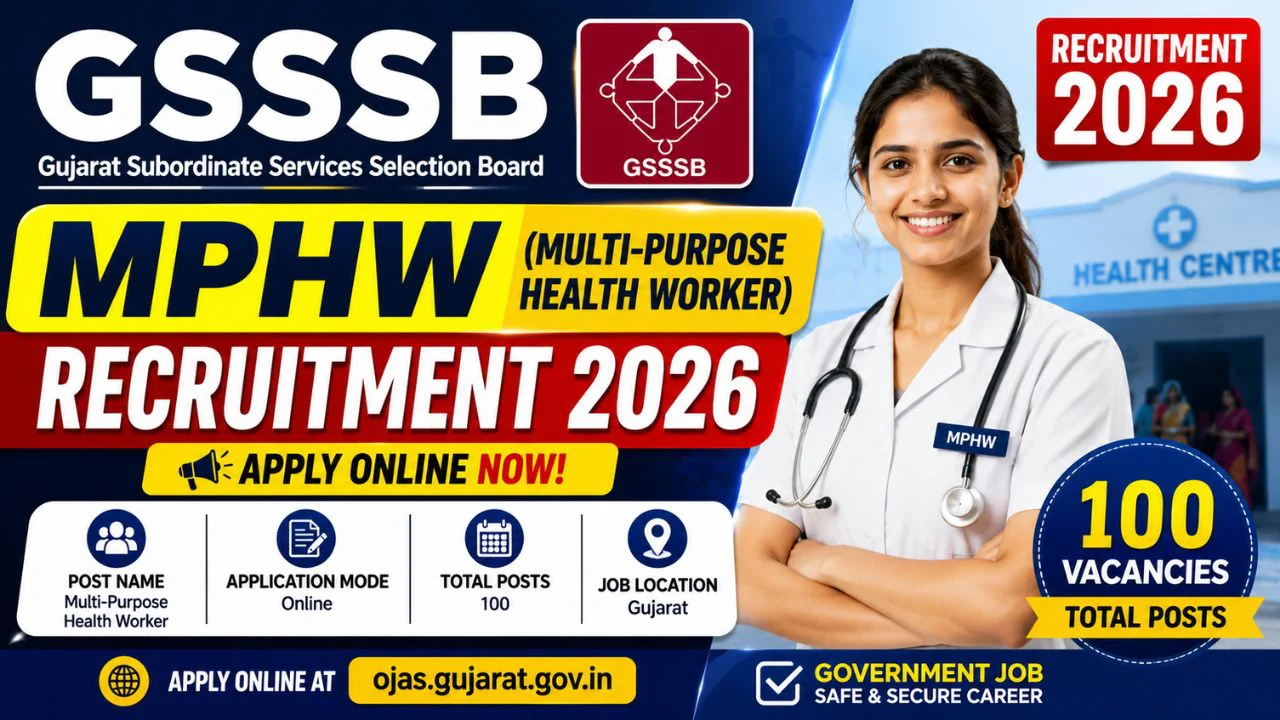
The Gujarat Subordinate Service Selection Board (GSSSB) has issued the comprehensive syllabus pattern for the competitive examination targeting the Multi-Purpose Health Worker (Male), Class-3 cadre (Advt. No. 441/202627). Aspirants preparing for this recruitment drive must align their preparation with the formally structured syllabus outlined below.
Gujarat GSSSB MPHW Exam Scheme Overview
The single-stage competitive examination is divided into two operational segments totaling 210 Questions evaluating candidates over a combined duration of 3 hours (180 minutes). A penalty framework of 1/4 (0.25) marks deduction applies to every incorrect attempt. Furthermore, an independent minimum qualifying standard of 40% is mandated for both Part-A and Part-B.
GSSSB MPHW Detailed Exam Syllabus
PART A: General & Core Aptitude (90 Marks)
1. Reasoning & Data Interpretation (30 Questions | 30 Marks)
Coding-Decoding
Blood Relation
Problems on Age and Height
Direction Knowledge
Clock and Calendar
Venn Diagram
Rank and Position
Arithmetic Progression
Logical Sequence of Words
Inserting the Missing Character
Word, Numerical, and General Analogy
Picture-Based General Logical Questions (Visual Reasoning)
Probability
Data Interpretation (Charts, Graphs, Tables) and Data Sufficiency
Symmetry
Mathematical Operations & Modeling
Proofs in Mathematics
Logical and Mathematical Analytical Ability
Statement and Prediction
2. Quantitative Aptitude (30 Questions | 30 Marks)
Number System
LCM and HCF
Percentage and Partnership
Profit-Loss
Simple and Compound Interest
Ratio and Proportion
Time and Work, Wages, and Chain Rule
Time, Speed, and Distance
Average, Mean, Mode, and Median
Brackets and Expansions
Square & Square Roots, Cube & Cube Roots, Exponents
Polynomials and Factorisation
Pair of Linear Equations in Two Variables and Quadratic Equations
Area, Surface Area, and Volume (Square, Rectangle, Triangle, Circle, Cube, Cuboid, Cylinder, Cone, Hemisphere, Sphere)
Coordinate Geometry and Trigonometry
3. Constitution of India (10 Questions | 10 Marks)
Concept of Political Science & Preamble of the Constitution
Fundamental values of Democracy, Nationalism, and Secularism
Rights and Citizenship
Indian Constitution: Framing and Characteristics
Fundamental Rights, Duties, and Directive Principles of State Policy (DPSP)
Structure of Legislature, Executive, and Judiciary at Union and State Levels
Local Governance: Institutions of Local Self-Government
Nature of the Party System and Elections in India
Indian Democracy: Challenges and Responses
Development and Democracy
4. Current Affairs (10 Questions | 10 Marks)
Evaluation of ongoing events possessing regional (Gujarat), national, and international significance.
5. Comprehension (10 Questions | 10 Marks)
Gujarati Comprehension (5 Marks): Paragraph exercises evaluating textual analysis, inference, and core linguistic interpretation.
English Comprehension (5 Marks): Paragraph-based query structures alongside statement-assertion formulations.
PART B: Technical & Professional Domain (120 Marks)
This structural division exclusively screens applications based on standard field rules and technical parameters relevant to healthcare execution.
1. Mental Health (20 Questions | 20 Marks)
Definitions and underlying characteristics of psychological health.
Fundamental causes driving psychiatric illnesses.
Classification and management profiles for minor and major mental ailments.
2. Communication, Counselling, and Health Education (20 Questions | 20 Marks)
Information, Education, and Communication (IEC) paradigms.
Behaviour Change Communication (BCC) and Social and Behaviour Change Communication (SBCC) protocols.
Core clinical counseling methodology.
3. Oral Health and Personal Hygiene (20 Questions | 20 Marks)
Protocols for proper care of the mouth and teeth.
Personal Hygiene: Systemic definitions, structural purposes, and surgical hand-wash standards.
Operational healthcare management routines for nursing a sick person.
4. Health Committees & Government Schemes (30 Questions | 30 Marks)
Historical Committees: Comprehensive study of Bhore, Mudaliar, Chaddah, Mukherji, Jungalwalla, Kartarsinh, and Shrivastav committee frameworks.
Policy Frameworks: Deep dive into the National Health Policy alongside running Central and State Government medical welfare schemes.
5. Epidemiology & Legal Acts (20 Questions | 20 Marks)
Common infectious/non-infectious diseases and their baseline treatment algorithms.
Birth and Death Registration Act protocols.
Statutory power guidelines and standard duties governing local Registrars.
6. Health Promotion & Wellness (10 Questions | 10 Marks)
Systematic health promotion practices.
Integrated holistic approaches towards patient recovery and the integration of structural Yoga methodologies.
Important Examination Rules & Language Guidelines
Language Medium: General parameters under Part-A (including Constitution and Current Events) alongside the core technical papers under Part-B will be set in both English and Gujarati. Language comprehensions remain strictly restricted to their own native alphabets. In scenarios concerning interpretative disputes, the original English content remains definitive.
Pro-Rata Adjustment: If any question faces technical cancellation post-provisional answer key challenge analysis, its scoring matrix adjusts across the remaining balance through standard pro-rata weight distributions.