
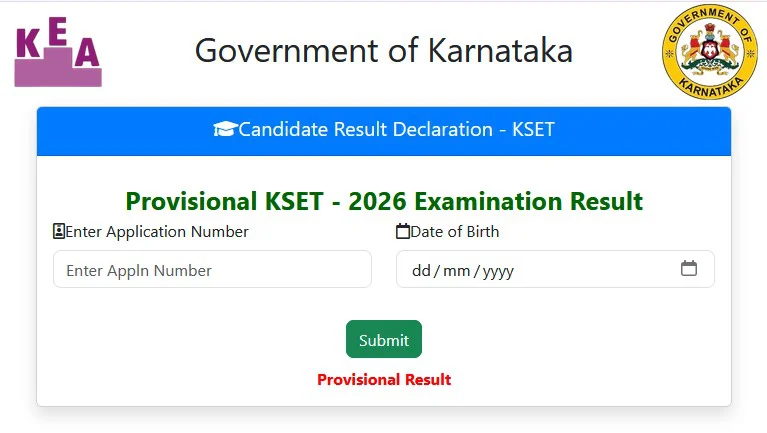
The Karnataka Examinations Authority (KEA) has released the provisional score list for the Karnataka State Eligibility Test (KSET) 2026. Candidates who appeared for the examination across 37 subjects on October 11, 2026 can now verify their marks online. This state-level eligibility test is a mandatory qualification for candidates aspiring to become Assistant Professors in universities and degree colleges across Karnataka. While the current release is a provisional score list, KEA will publish the final merit list, subject-wise cut-off marks, and eligibility certificates shortly after resolving any discrepancies and verifying category submissions.
KSET Result 2026 Summary
| Conducting Authority | Karnataka Examinations Authority (KEA) |
| Exam Name | Karnataka State Eligibility Test (KSET) 2026 |
| Post Purpose | Eligibility for Assistant Professor |
| Exam Date | 11 October 2026 |
| Result Status | Provisional Score List Released |
| Result Declaration | 26 October 2026 (10:30 AM) |
| Total Subjects | 37 Subjects |
| Official Website | cetonline.karnataka.gov.in/kea |
KSET 2026 Exam Details
The KSET 2026 examination was conducted in an offline, OMR-based format comprising two distinct papers designed to evaluate both general teaching aptitude and specific subject mastery.
- Paper I (General): Focused on Teaching and Research Aptitude, this paper was common for all candidates. It contained 50 objective questions carrying a total of 100 marks.
- Paper II (Subject-Specific): Based on the subject chosen by the candidate from 37 available options. It consisted of 100 objective questions for a total of 200 marks.
To qualify for the eligibility certificate, candidates must meet the minimum aggregate marks across both papers:
General / Unreserved Category: 40% aggregate marks
Reserved Categories (SC, ST, OBC, PwD): 35% aggregate marks
Important Dates to Remember
| Event | Date |
| KSET 2026 Exam Date | 11 October 2026 |
| Provisional Answer Key Release | 12 October 2026 |
| Revised Answer Key Publication | 23 October 2026 |
| Provisional Score List Released | 26 October 2026 |
| Category Details Submission (SCA/SCB/SCC) | Opens 28 October 2026 (10:00 AM) |
| Final Merit List & Cut Off | To be announced |
How to Check the Provisional Score List
- Open the web browser and navigate to the official KEA website at
cetonline.karnataka.gov.in/kea. - Scroll to the “Latest Announcements” or the dedicated “KSET 2026” section on the homepage and click on the link for the KSET 2026 Provisional Score List.
- It will be redirected to a secure login page. Enter the KSET Application Number and Date of Birth correctly.
- Click on submit. the paper-wise marks for Paper I and Paper II, along with your total score and category details, will be displayed on the screen.
- Download the provisional score list PDF and take a printout. Keep this document safe until the final eligibility certificate is issued.
Important Links
| Karnataka KSET Result 2026 Direct Link | Click Here |
| Karnataka KEA Official Website Link | Click Here |
KSET Cutoff 2026
The calculation of the final subject-wise and category-wise cut-off marks for the Karnataka State Eligibility Test (KSET) is not based on a fixed percentage. Instead, the Karnataka Examinations Authority (KEA) follows a strict multi-step methodology mandated by UGC-NET guidelines to determine the final cut-offs.
Here is the step-by-step process of how KEA calculates the final cut-off marks:
Step 1: Clearing the Minimum Qualifying Threshold
First, candidates must secure the minimum baseline aggregate marks in Paper I and Paper II combined. Candidates who score below this threshold are immediately disqualified from the merit calculation.
General / Unreserved: Minimum 40% aggregate marks (120 out of 300).
Reserved Categories (SC, ST, OBC, PwD, Transgender): Minimum 35% aggregate marks (105 out of 300).
Step 2: The “Top 6%” Rule
Securing the minimum qualifying marks does not mean a candidate has qualified. The total number of candidates who will be awarded the KSET Eligibility Certificate is restricted to 6% of the total candidates who appeared for both papers of the KSET exam. This 6% forms the total available “slots.”
Step 3: Application of Reservation Policy
The total available slots (the 6% calculated in Step 2) are then divided among various categories (General, SC, ST, OBC groups, etc.) strictly according to the reservation policy defined by the Government of Karnataka.
Step 4: Subject-wise and Category-wise Slot Allocation
Next, KEA calculates how many slots go to each specific subject within a particular category. This is done using a proportional formula:
Slots for Subject ‘X’ in Category ‘Y’ =
(Number of candidates from Category ‘Y’ who secured minimum qualifying marks in Subject ‘X’)
÷
(Total number of candidates from Category ‘Y’ who secured minimum qualifying marks across all 37 subjects)
× (Total slots available for Category ‘Y’)
This ensures that subjects with more passing candidates receive a proportionately higher number of qualifying slots.
Step 5: Final Merit List and Cut-off Determination
Once the exact number of slots for each subject and category is determined, KEA arranges the candidates (who met the baseline marks in Step 1) in descending order of their aggregate marks.
If a specific category in a specific subject has 20 allocated slots, the top 20 candidates in that list will qualify. The marks scored by the 20th candidate (the last selected candidate) officially become the cut-off score for that subject and category.
This is why cut-offs fluctuate every year—they depend entirely on the difficulty of the paper and how the top 6% of candidates perform relative to one another.
KEA KSET Reservation Policy
The Government of Karnataka implements a 50% vertical reservation policy for state-level eligibility tests like KSET and state government jobs, fully utilizing the Supreme Court’s mandated ceiling. The remaining 50% of slots fall under the General Merit (Unreserved) category.
Unlike the central reservation system which groups all Other Backward Classes (OBCs) together, Karnataka divides the OBC quota into five distinct sub-categories.
Here is the exact percentage breakdown of the reservation policy:
| Category | Sub-Group Details | Reservation Percentage |
| General Merit (GM) | Open to all candidates based on merit | 50% |
| SC | Scheduled Castes | 15% |
| ST | Scheduled Tribes | 3% |
| Category – I | Denotified, Nomadic, and Semi-Nomadic Tribes | 4% |
| Category – II (A) | OBC (Non-Muslim agricultural/artisan communities) | 15% |
| Category – II (B) | OBC (Specific Muslim communities) | 4% |
| Category – III (A) | OBC (Vokkaliga and allied communities) | 4% |
| Category – III (B) | OBC (Lingayat and allied communities) | 5% |
(Note: Category I, IIA, IIB, IIIA, and IIIB collectively make up the 32% OBC reservation in the state).
Horizontal and Special Reservations
In addition to this vertical caste-based breakdown, Karnataka applies horizontal reservations that cut across these categories. For Assistant Professor recruitments following KSET, this typically includes:
Kalyana Karnataka (Article 371J): A separate localized reservation where a specific percentage (usually 70% in regional universities and 8% in statewide institutions) is reserved for local candidates of the Hyderabad-Karnataka region (Bidar, Kalaburagi, Yadgir, Raichur, Koppal, and Ballari).
Persons with Benchmark Disabilities (PwD): Typically a 4% to 5% horizontal quota applied proportionately within each vertical category pool.
Women’s Quota: A 30% horizontal reservation applied within each category pool.