The Staff Selection Commission (SSC) has released the SSC JE Notification 2026, announcing 1748 tentative vacancies for the recruitment of Junior Engineers and Scientific Assistants. Aspiring candidates must thoroughly understand the SSC JE Syllabus 2026 and Exam Pattern to strategically plan their preparation. The selection process involves two comprehensive Computer-Based Examinations (Paper-I and Paper-II) designed to assess both general aptitude and core engineering proficiency. This article provides a complete breakdown of the exam structure, detailed syllabus, and effective preparation tips to help you secure a position in prestigious government departments.
SSC JE 2026 Exam Overview
| Exam Name | SSC Junior Engineer Examination 2026 |
| Organizing Body | Staff Selection Commission (SSC) |
| Posts Offered | Junior Engineer (Civil, Mechanical, Electrical, Telecom) & Scientific Assistant |
| Total Vacancies | 1748 (Tentative) |
| Mode of Examination | Online (Computer-Based Examination) |
| Selection Stages | Paper-I, Paper-II, and Document Verification |
| Official Website | ssc.gov.in |
SSC JE Selection Criteria
The Staff Selection Commission follows a strict multi-stage selection process to recruit suitable candidates.
- Paper-I (Computer-Based Examination): This is the preliminary screening stage. It is qualifying in nature, and candidates are shortlisted for the next stage based on their normalized marks.
- Paper-II (Computer-Based Examination): This stage evaluates in-depth technical knowledge. The final merit list is primarily determined by the normalized scores obtained in this paper, along with the candidate’s post preferences.
- Minimum Qualifying Marks: To be considered for shortlisting, candidates must secure minimum qualifying marks: 30% for UR, 25% for OBC/EWS, and 20% for all other categories.
- Document Verification (DV): Shortlisted candidates will be called for DV by the respective User Departments to authenticate their educational and category certificates.
SSC JE Exam Pattern 2026
The SSC JE 2026 Examination consists of two separate papers, both conducted online as Computer-Based Examinations featuring objective-type, multiple-choice questions. Paper-I combines non-technical and technical sections, carrying 200 marks with a negative marking of 0.25 marks for every incorrect answer. Paper-II is an advanced technical test carrying 300 marks, where 1 mark is deducted for each wrong response. Both papers have a time duration of 2 hours each.
| Paper | Subjects | Number of Questions | Maximum Marks | Time Duration | Negative Marking |
| Paper-I | General Intelligence and Reasoning | 50 | 50 | 2 Hours | 0.25 Marks per wrong answer |
| General Awareness | 50 | 50 | |||
| General Engineering (Specific Branch) | 100 | 100 | |||
| Paper-II | General Engineering (Specific Branch) | 100 | 300 | 2 Hours | 1.0 Mark per wrong answer |
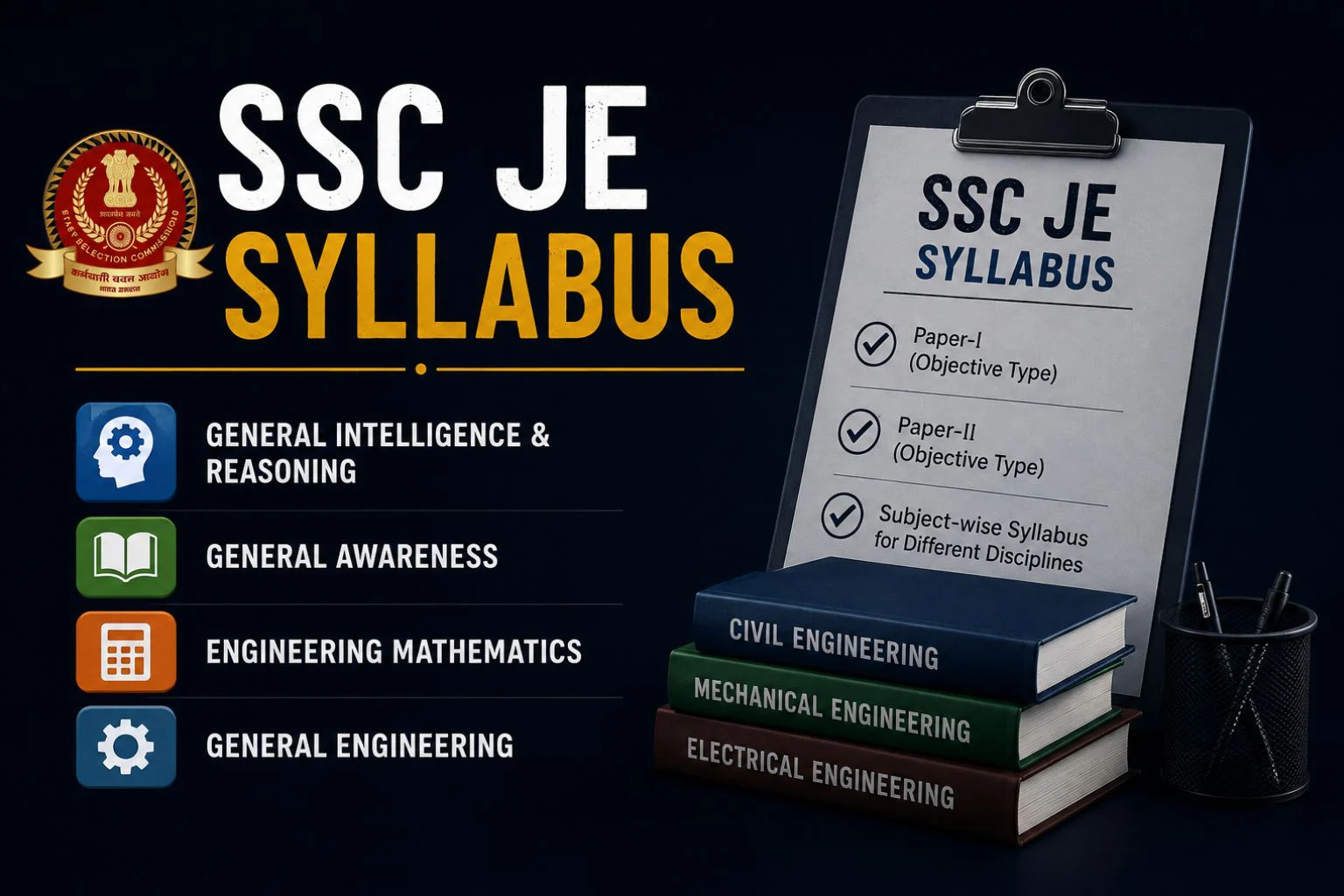
SSC JE Syllabus
Syllabus for Paper-I
Non-Technical Subjects (Compulsory for All)
- General Intelligence & Reasoning: Includes both verbal and non-verbal questions. Topics cover analogies, similarities, differences, space visualization, problem-solving, analysis, judgment, decision-making, visual memory, discrimination, observation, relationship concepts, arithmetical reasoning, verbal and figure classification, and arithmetical number series. It also tests the ability to deal with abstract ideas, symbols, arithmetical computations, and analytical functions.
- General Awareness: Tests knowledge of current events and everyday scientific observations. Includes questions relating to India and neighboring countries, pertaining specifically to History, Culture, Geography, Economic Scene, General Polity, and Scientific Research.
Core Engineering Subjects (Attempt Any One Based on Qualification)
- Part-A (Civil Engineering): Engineering Mechanics, Solid Mechanics, Structural Analysis, Construction Materials and Management, Estimating, Costing and Valuation, Concrete Structures, Steel Structures, Surveying, Soil Mechanics (Geotechnical Engineering), Fluid Mechanics and Hydraulics, Hydrology and Irrigation Engineering, Environmental Engineering, and Transportation (Traffic) Engineering.
- Part-B (Electrical Engineering): Fundamentals of Electrical Engineering, Magnetic Circuits, A.C. Fundamentals, Measurement and Measuring Instruments, Electrical Machines, Special Electric Machines and Synchronous Generators, Generation, Transmission and Distribution, Estimation & Costing, Utilization of Electrical Energy, Basic Electronics, and Power Electronics.
- Part-C (Mechanical Engineering): Engineering Mechanics, Strength of Materials, Theory of Machines, Machine Design, Materials Science and Engineering, Thermal Engineering, Fluid Mechanics and Hydraulic Machinery, Industrial Engineering, Manufacturing Engineering, Metrology and Measurement, and Advanced Manufacturing Processes.
- Part-D (Computer Science and Information Technology): Engineering Mathematics, Digital Logic, Computer Organization and Architecture, Programming and Data Structures, Algorithms, Theory of Computation, Compiler Design, Operating System, Databases, and Computer Networks.
- Part-E (Electronics and Telecommunication Engineering):
- Electronics: Electronic Materials & Components, Diodes, Transistors, Amplifiers & Oscillators, Voltage Regulation, Introduction to Network Theorems, AC Circuits, Three-Phase Circuits, Resonance, Digital Electronics, Sequential & Combinational Logic, and Data Conversion & Codes.
- Telecommunications: Antennas, Radio Wave Propagation, Electromagnetic Spectrum, Modulation, Single Sideband, Frequency Modulation, Pulse Modulation, Multiplexing, Introduction to Digital Communication, and Radio Frequency Communications & Wireless Telecommunications.
- Part-F (Physics): Mathematical Methods, Mechanics, General Properties of Matter, Oscillations, Waves, Optics, Electricity, Magnetism, Kinetic Theory, Thermodynamics, Modern Physics, Solid State Physics, Semiconductor Devices, and Analog and Digital Electronics.
- Part-G (Telecommunications): Engineering Mathematics, Network Analysis, Signals and Systems, Electronic Devices, Analog Circuits, Digital Circuits, Control Systems, Analog Communications, Digital Communications, and Electromagnetics.
Syllabus for Paper-II
Paper-II requires candidates to dive deeper into their specific engineering domains. The broad topics covered for each branch include:
- Part-A (Civil & Structural Engineering): Engineering Mechanics, Solid Mechanics, Structural Analysis, Construction Materials and Management (including PERT and CPM), Estimating, Costing and Valuation, Concrete Structures (Working stress and Limit State design), Steel Structures, Surveying (including Total Station and Theodolite), Soil Mechanics, Fluid Mechanics, Hydraulics, Hydrology, Irrigation, Water and Wastewater Quality and Treatment, Air Pollution, Municipal Solid Wastes, Transportation Infrastructure, Highway Pavements, and Traffic Engineering.
- Part-B (Electrical Engineering): Fundamentals of Electrical Engineering, Network Solution Methods (KCL, KVL, Node/Mesh), Network Theorems, Magnetic Circuits, A.C. Fundamentals, Measurement and Measuring Instruments, Electrical Machines (Transformers, DC/AC Machines), Special Electric Machines and Synchronous Generators, Generation, Transmission and Distribution, Estimation & Costing, Utilization of Electrical Energy, Basic Electronics, and Power Electronics (Thyristors, Converters, Rectifiers).
- Part-C (Mechanical Engineering): Engineering Mechanics, Strength of Materials, Theory of Machines, Machine Design, Materials Science and Engineering, Thermal Engineering (including Thermodynamics, Power Plants, IC Engines, Refrigeration, Gas Turbines, Heat Transfer), Fluid Mechanics and Hydraulic Machinery, Industrial Engineering, Manufacturing Engineering (Casting, Welding, Machining), Metrology and Measurement, and Advanced Manufacturing Processes (CNC, PLC, Non-Traditional Machining).
- Part-D (Computer Science and Information Technology): Engineering Mathematics (Discrete Math, Linear Algebra, Calculus, Probability & Statistics), Digital Logic, Computer Organization and Architecture, Programming and Data Structures, Algorithms, Theory of Computation, Compiler Design, Operating System, Databases, and Computer Networks.
- Part-E (Electronics and Telecommunication Engineering): Detailed components of Electronics (Diodes, Transistors, Amplifiers, Voltage Regulation, AC/Three-Phase Circuits, Digital Electronics) and Telecommunication (Antennas, Wave Propagation, Spectrum, Modulation techniques including AM, FM, PM, PCM, Multiplexing, RF Communications).
- Part-F (Physics): Advanced concepts in Mathematical Methods, Mechanics, General Properties of Matter, Oscillations, Waves, Optics, Electricity, Magnetism, Kinetic Theory, Thermodynamics, Modern Physics, Solid State Physics, Semiconductor Devices, and Analog and Digital Electronics.
- Part-G (Telecommunication Engineering): Engineering Mathematics (Linear Algebra, Calculus, Differential Equations, Vector/Complex Analysis, Probability), Network Analysis, Signals and Systems, Electronic Devices, Analog Circuits, Digital Circuits, Computer Organization, Control Systems, Analog Communications, Digital Communications (Information Theory, Error Correction Codes), and Electromagnetics.
PDF
SSC JE Syllabus 2026 PDF
Download PDF